

Description
What our Subtraction – Unknown Addends lesson plan includes
Lesson Objectives and Overview: Subtraction – Unknown Addends teaches students how to look at subtraction problems as unknown addend problems. At the end of the lesson, students will be able to understand subtraction as an unknown addend problem. This lesson is for students in 1st grade.
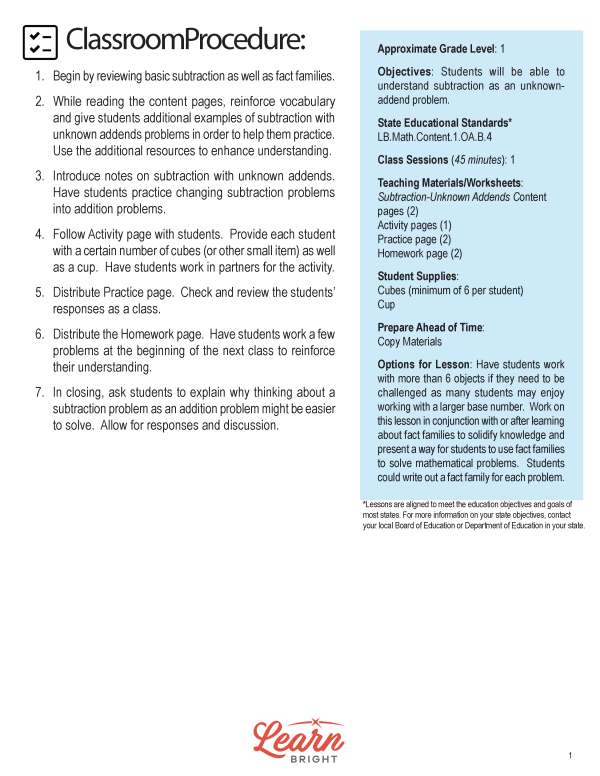
Classroom Procedure
Every lesson plan provides you with a classroom procedure page that outlines a step-by-step guide to follow. You do not have to follow the guide exactly. The guide helps you organize the lesson and details when to hand out worksheets. It also lists information in the blue box that you might find useful. You will find the lesson objectives, state standards, and number of class sessions the lesson should take to complete in this area. In addition, it describes the supplies you will need as well as what and how you need to prepare beforehand.
Options for Lesson
Included with this lesson is an “Options for Lesson” section that lists a number of suggestions for activities to add to the lesson or substitutions for the ones already in the lesson. One optional adjustment to the lesson activity is to have students work with more than six objects if they need to be challenged, as many students may enjoy working with a larger base number. You could also teach this lesson in conjunction with or after learning about fact families to solidify knowledge and present a way for students to use fact families to solve mathematical problems. Finally, you could have your students write out a fact family for each problem in the lesson.
Teacher Notes
The teacher notes page includes a paragraph with additional guidelines and things to think about as you begin to plan your lesson. This page also includes lines that you can use to add your own notes as you’re preparing for this lesson.
SUBTRACTION – UNKNOWN ADDENDS LESSON PLAN CONTENT PAGES
Subtraction – Unknown Addends
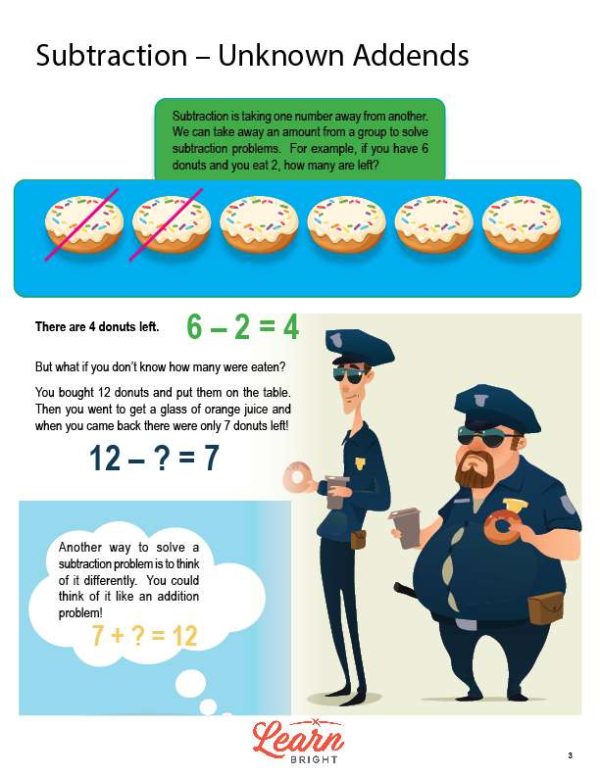
The Subtraction – Unknown Addends lesson plan includes two content pages. Subtraction is when you take one number away from another. For example, if you have six donuts and eat 2, how many do you have left? To solve, you use a subtraction problem: 6 – 2 = 4 donuts left.
However, you won’t always know how many of something to take away. For example, say you bought 12 donuts and put them on a table. You leave, and when you come back there are 7 donuts left. How many donuts got eaten while you were gone? If you write this as a subtraction problem, you get: 12 – ? = 7.
Sometimes, to solve a subtraction problem, you can think of it like an addition problem. For the above example, ask yourself: 7 + ? = 12. What number added to 7 makes 12? The answer is 5, so 12 – 5 = 7. This is how you can solve subtraction problems using addition.
Fact families are groups of math facts that use the same numbers. For addition and subtraction, if you have three numbers, you have four facts. For example, let’s look at the fact family for the numbers 11, 7, and 4: 7 + 4 = 11, 4 + 7 = 11, 11 – 7 = 4, and 11 – 4 = 7. Fact families can make it easier to solve subtraction problems with a missing number.
Let’s look an another example: 8 – ? = 5. To make this an addition problem, rewrite the problem: 5 +? = 8. You can think of this as reading the subtraction backwards with addition. To solve, you know that 5 + 3 = 8, so the ? (called the missing addend) is 3.
Let’s take a look at another example problem: 14 – ? = 3. Rewrite the problem with addition: 3 + ? = 14. To solve, think of your fact families. You know that 3 + 11 = 14, so the missing addend is 11.
Finally, let’s look at one more example: 9 – ? = 2. Rewrite it with addition: 2 + ? = 9. Now solve! You know that 2 + 7 = 9, so the missing addend is 7.
SUBTRACTION – UNKNOWN ADDENDS LESSON PLAN WORKSHEETS
The Subtraction – Unknown Addends lesson plan includes three worksheets: an activity worksheet, a practice worksheet, and a homework assignment. You can refer to the guide on the classroom procedure page to determine when to hand out each worksheet.
CUBES ACTIVITY WORKSHEET
Students will work with a partner to complete the lesson activity. Each pair will use six cubes (or another small object). The students will take turns closing their eyes while the other student places an unknown number of cubes under a cup. The first student will then open their eyes and use subtraction to figure out how many cubes are under the cup. Each student should complete at least four problems each, showing their work and recording their answers on a sheet of paper.
SUBTRACTION TO ADDITION PRACTICE WORKSHEET
For the practice worksheet, students will write each of the subtraction problems on the worksheet as an addition problem and solve.
SUBTRACTION – UNKNOWN ADDENDS HOMEWORK ASSIGNMENT
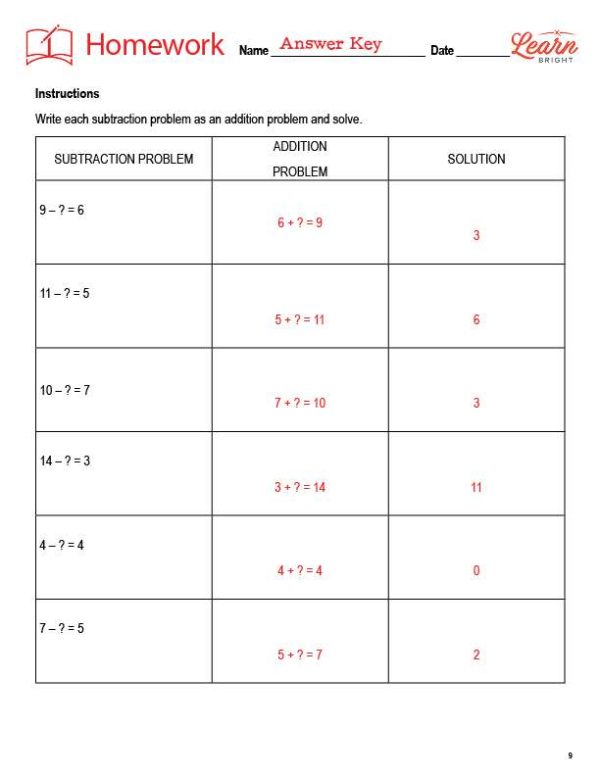
Like the practice worksheet, for the homework assignment, students will write each of the subtraction problems on the worksheet as an addition problem and solve.
Worksheet Answer Keys
This lesson plan includes answer keys for the practice worksheet and the homework assignment. If you choose to administer the lesson pages to your students via PDF, you will need to save a new file that omits these pages. Otherwise, you can simply print out the applicable pages and keep these as reference for yourself when grading assignments.