




Description
What our Skip Counting Patterns with Tables lesson plan includes
Lesson Objectives and Overview: Skip Counting Patterns with Tables teaches students how to skip count with 5s, 10s, and 100s. At the end of the lesson, students will be able to skip count with 5s, 10s, and 100s using a table. This lesson is for students in 2nd grade.
Classroom Procedure
Every lesson plan provides you with a classroom procedure page that outlines a step-by-step guide to follow. You do not have to follow the guide exactly. The guide helps you organize the lesson and details when to hand out worksheets. It also lists information in the blue box that you might find useful. You will find the lesson objectives, state standards, and number of class sessions the lesson should take to complete in this area. In addition, it describes the supplies you will need as well as what and how you need to prepare beforehand.
Options for Lesson
Included with this lesson is an “Options for Lesson” section that lists a number of suggestions for activities to add to the lesson or substitutions for the ones already in the lesson. One optional addition to this lesson is to provide laminated hundreds boards to your students to use for practice circling answers while skip counting. You could also have your students highlight or color all of the 5s on a hundreds board, then all of the 10s. To make skip counting easier, you can encourage your students to use color to mark their pattern on the table as they count. Finally, make sure to provide enough tables for your students to use in various ways during the lesson.
Teacher Notes
The teacher notes page includes a paragraph with additional guidelines and things to think about as you begin to plan your lesson. This page also includes lines that you can use to add your own notes as you’re preparing for this lesson.
SKIP COUNTING PATTERNS WITH TABLES LESSON PLAN CONTENT PAGES
Skip Counting Patterns with Tables
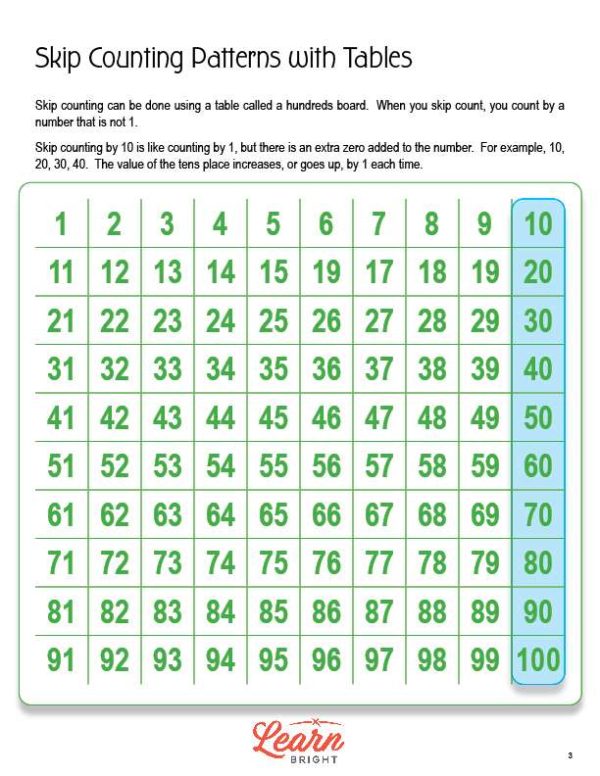
The Skip Counting Patterns with Tables lesson plan includes four content pages. You can skip count using a table called a hundreds board. Skip counting is simply counting by a number other than one.
Skip counting by 10 is very similar to counting by 1, except with an extra zero! For example, when skip counting by 10, you count 10, 20, 30, 40, and so on. The value of the tens place increases by 1 each time.
Similarly, skip counting by 100 is much like counting by 1, except with two extra zeroes. When skip counting by 100, you count 100, 200, 300, 400, and so on. In this case, the value of the hundreds place increases by 1 each time.
Skip Counting by Other Numbers
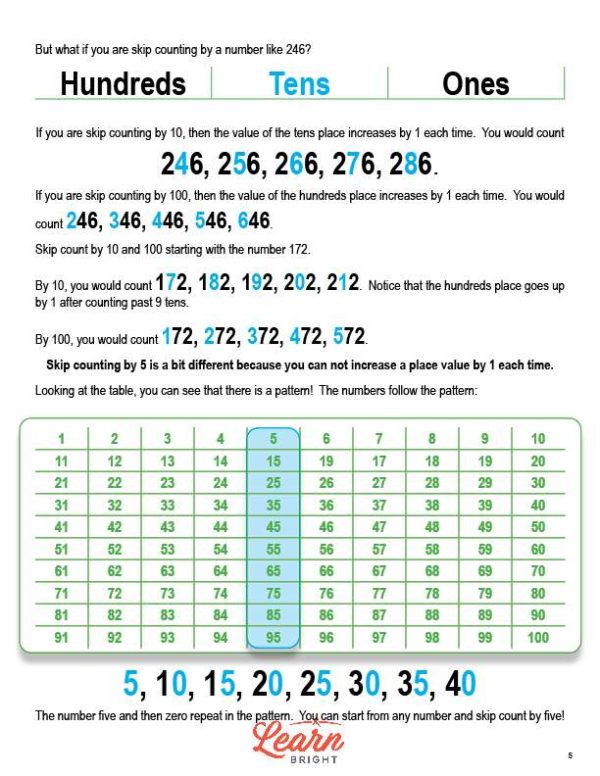
But what if you want to skip count by a number that doesn’t end in a zero? For example, let’s take a look at the number 246. If you start with 246 and want to skip count by 10, you simply add 1 to the value of the tens place each time. Therefore, you would count 246, 256, 266, 276, 286, and so on.
If you start with 246 and want to skip count by 100, it’s the same process, except that you add 1 to the value of the hundreds place this time. You would get 246, 346, 446, 546, 646, and so on.
Let’s take a look at another example. Say you wanted to start with the number 172 and skip count by 10 and 100. By 10, you would count 172, 182, 192, 202, 212, and so on. By 100, you would count 172, 272, 372, 472, 572, and so on.
Skip Counting by 5
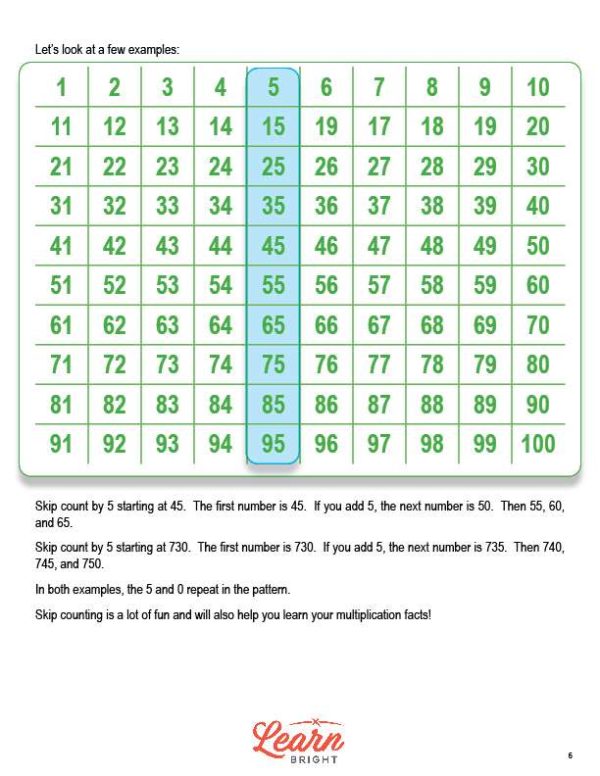
The process for skit counting by 5 is a little more complicated, since you can’t just increase one of the place values by 1 each time. However, there’s still a pattern that you can follow. The lesson includes a helpful chart that highlights the numbers you would get if you skip counted by 5 starting with 5. You would get 5, 10, 15, 20, 25, 30, and so on. These numbers follow a pattern, ending in 5 and 0.
Let’s take a look at a few examples. Say you wanted to skip count by 5 starting with 45. Simply add 5 to each number to get 45, 50, 55, 60, 65, 70, and so on. If you wanted to skip count by 5 starting with 730, you use the same process to get 730, 735, 740, 745, 750, and so on. In both examples, the ones place has a pattern, switching back and forth between 5 and 0.
Skip counting can be a lot of fun and can help you learn your multiplication facts!
SKIP COUNTING PATTERNS WITH TABLES LESSON PLAN WORKSHEETS
The Skip Counting Patterns with Tables lesson plan includes three worksheets: an activity worksheet, a practice worksheet, and a homework assignment. You can refer to the guide on the classroom procedure page to determine when to hand out each worksheet.
BOOKLET ACTIVITY WORKSHEET
The activity worksheet asks students to use the hundreds chart on the worksheet to make their own tables from 1 to 1,000. When they are done, they will staple or bind the charts together to create a booklet.
5, 10, 100 PRACTICE WORKSHEET
For the practice worksheet, students will count by 5s, 10s, and 100s using the tables.
SKIP COUNTING PATTERNS WITH TABLES HOMEWORK ASSIGNMENT
Like the practice worksheet, for the homework assignment, students will count by 5s, 10s, and 100s using the tables.
Worksheet Answer Keys
This lesson plan includes answer keys for the practice worksheet and the homework assignment. If you choose to administer the lesson pages to your students via PDF, you will need to save a new file that omits these pages. Otherwise, you can simply print out the applicable pages and keep these as reference for yourself when grading assignments.


