


Description
What our Time Estimation lesson plan includes
Lesson Objectives and Overview: Time Estimation teaches students how to read both digital and analog clocks, as well as how to use “AM” and “PM”. At the end of the lesson, students will be able to tell and write time from analog and digital clocks to the nearest five minutes, using a.m. and p.m. This lesson is for students in 2nd grade.
Classroom Procedure
Every lesson plan provides you with a classroom procedure page that outlines a step-by-step guide to follow. You do not have to follow the guide exactly. The guide helps you organize the lesson and details when to hand out worksheets. It also lists information in the blue box that you might find useful. You will find the lesson objectives, state standards, and number of class sessions the lesson should take to complete in this area. In addition, it describes the supplies you will need as well as what and how you need to prepare beforehand.
Options for Lesson
Included with this lesson is an “Options for Lesson” section that lists a number of suggestions for activities to add to the lesson or substitutions for the ones already in the lesson. One optional addition to the lesson activity is to have your students create a poster showing the different times of the day they used for the activity, including pictures related to the activities or events. You can also distribute a chart to each student and ask them to write down the time at least ten times throughout the day and to list the event or what they were doing at that time (you may also choose to do this along with the class throughout the day). Finally, you can invite a jeweler or a watch/clock expert to share information about the mechanisms of a clock and how clocks and watches work.
Teacher Notes
The teacher notes page includes a paragraph with additional guidelines and things to think about as you begin to plan your lesson. This page also includes lines that you can use to add your own notes as you’re preparing for this lesson.
TIME ESTIMATION LESSON PLAN CONTENT PAGES
Telling Time
The Time Estimation lesson plan includes three content pages. People use time to measure the length of our days, nights, events, and more. Class periods at a school are scheduled for a set amount of time. Children may have a specific bedtime and a specific time when they need to wake up. Learning how to tell and measure time is a very important skill!
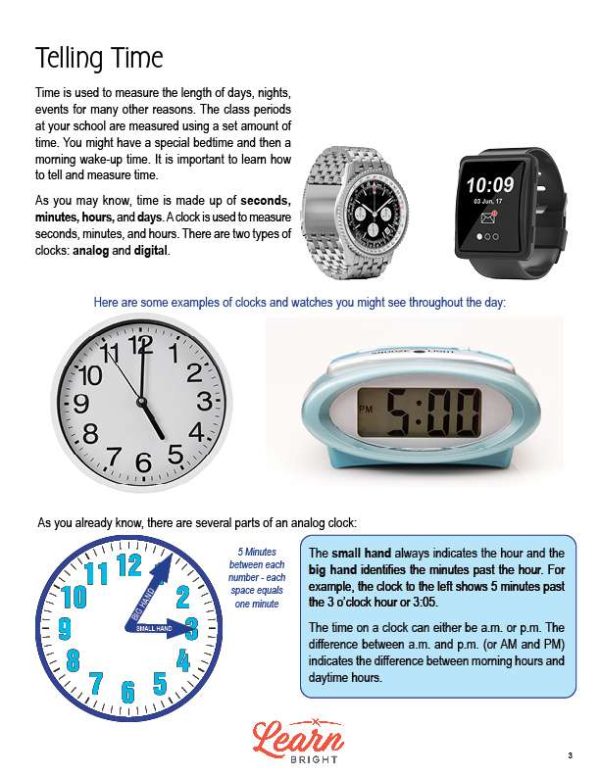
Time is made up of seconds, minutes, hours, and day. It is measured using clocks that show seconds, minutes, and hours. Two main types of clocks exist: analog and digital.
Analog clocks have several important parts. The small hand on a clock indicates the hour and the large hand indicates the minutes past the hour. For example, a clock with its small hand pointing at the 3 and its large hand pointing at the 1 is showing the time 3:05, or 5 minutes past the 3 o’clock hour.
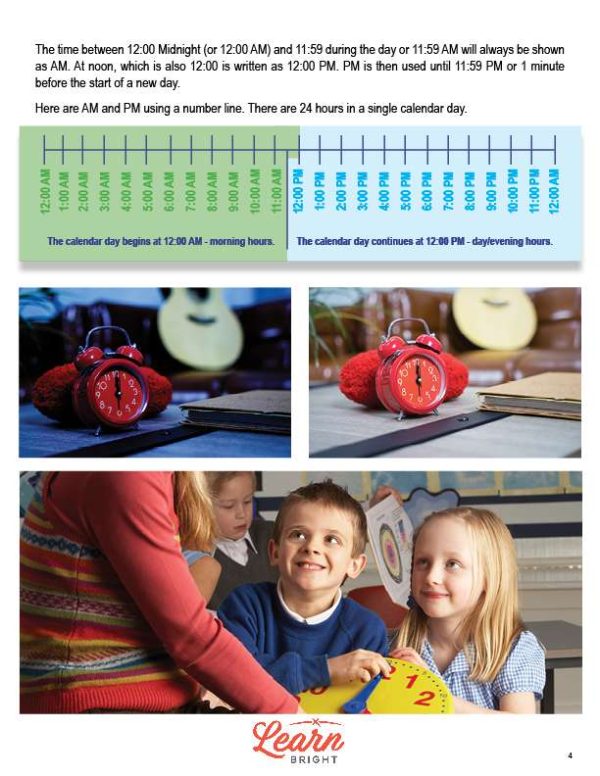
The time on a clock can be either AM or PM. The difference is that AM is the morning and PM is the afternoon/night. Times between midnight (12:00) and 11:59 during the day are AM. At noon (12:00), it switches to PM until 11:59 at night. The lesson includes a helpful number line showing which times are AM and which are PM.
More AM/PM and Estimation
A clock shows each time twice a day. For example, the time 3:05 on a clock can mean either 3:05 AM or 3:05 PM. Remember that AM means morning hours and PM means daytime hours. Kids go to school when the time is AM and leave school when the time is PM.
People who use analog clocks often estimate the time to the nearest 5 minutes. For example, the lesson shows a clock that reads 1:03, but someone reading that clock might say it’s about 1:05 or five minutes past one.
People use many different phrases when telling the time. For example, at 12:30, someone might say it’s “twelve-thirty” or “half past twelve.” At 2:10, someone might say “two-ten” or “ten after two.” The lesson includes a few more examples as well. Learning the different ways people say the time is useful, as it will help you understand what they’re trying to say more easily.
Many people use digital clocks instead of analog clocks. Digital clocks don’t have hands. The numbers on a digital clock show the exact time. However, people still estimate the time to the nearest 5 minutes with digital clocks sometimes, even though they’re easier to read.
A main difference between many digital clocks and analog clocks is the second hand. On an analog clock, the second hand shows the number of seconds that have passed. One minute has 60 seconds and one hour has 60 minutes. The second hand on an analog clock often looks a little different. Sometimes, it is red! This makes it easier to read. When reading the second hand on a clock, people often estimate. They might say that about 20 seconds have passed since the prior minute.
Learning to tell the time using both analog and digital clocks is important. Try practicing telling the time throughout the day, or whenever you see a clock. Always remember that the morning hours are AM and the evening hours are PM!
TIME ESTIMATION LESSON PLAN WORKSHEETS
The Time Estimation lesson plan includes three worksheets: an activity worksheet, a practice worksheet, and a homework assignment. You can refer to the guide on the classroom procedure page to determine when to hand out each worksheet.
EVENT TIMES ACTIVITY WORKSHEET
For the activity worksheet, students will choose ten events or activities that they participate in throughout the day. They will write in the time of each event, drawing the hands on an analog clock and writing in the name of the event and a short description. They should use AM/PM.
AM OR PM PRACTICE WORKSHEET
The practice worksheet asks students to tell whether each event listed is likely to take place during AM or PM hours. They will then estimate each of the times on the analog clocks shown on the worksheet to the nearest 5 minutes.
TIME ESTIMATION HOMEWORK ASSIGNMENT
For the homework assignment, students will read each time phrase and write the correct time as it would appear on a digital clock.
Worksheet Answer Keys
This lesson plan includes answer keys for the the practice worksheet and the homework assignment. If you choose to administer the lesson pages to your students via PDF, you will need to save a new file that omits these pages. Otherwise, you can simply print out the applicable pages and keep these as reference for yourself when grading assignments.