




Description
What our Solving Word Problems lesson plan includes
Lesson Objectives and Overview: Solving Word Problems develops math problem-solving strategies for young students. This interactive lesson equips students to identify and define keywords and use pictures or diagrams for math problem solving (addition and subtraction). At the end of the lesson, students will be able to identify and define keywords and use pictures or diagrams for math problem solving (addition and subtraction). This lesson is for students in 1st grade and 2nd grade.
Classroom Procedure
Every lesson plan provides you with a classroom procedure page that outlines a step-by-step guide to follow. You do not have to follow the guide exactly. The guide helps you organize the lesson and details when to hand out worksheets. It also lists information in the blue box that you might find useful. You will find the lesson objectives, state standards, and number of class sessions the lesson should take to complete in this area. In addition, it describes the supplies you will need as well as what and how you need to prepare beforehand.
Options for Lesson
Included with this lesson is an “Options for Lesson” section that lists a number of suggestions for activities to add to the lesson or substitutions for the ones already in the lesson. One optional addition to this lesson is to collect all of the activity problems and turn them into a booklet for every student. If your students need more practice using the different methods, you can use the additional resources to find more practice problems. You could also increase the number of word problems during the activity. Finally, you could try distributing manipulatives to help your students solve word problems.
Teacher Notes
The teacher notes page includes a paragraph with additional guidelines and things to think about as you begin to plan your lesson. This page also includes lines that you can use to add your own notes as you’re preparing for this lesson.
SOLVING WORD PROBLEMS LESSON PLAN CONTENT PAGES
Solving Word Problems
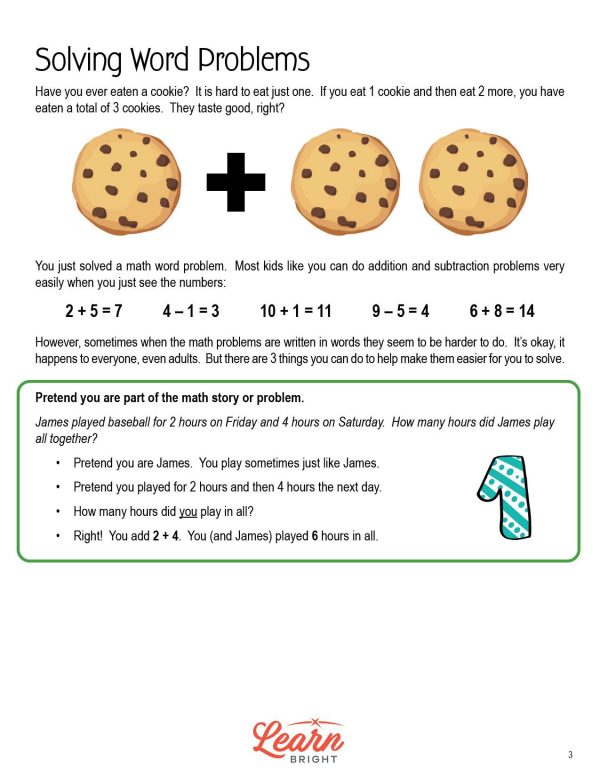
The Solving Word Problems lesson plan includes three content pages. Have you ever eaten a cookie? It can be hard to eat only one! If you eat one and then eat two more, you’ve eaten a total of three cookies. You also just solved a math word problem.
It’s easy to solve addition and subtraction problems when you look at the numbers, but word problems can often seem much harder. However, there are three things you can do to help make them easier to solve.
Method 1
For our first method, try to pretend you are part of the math story or problem. Let’s look at an example: James played baseball for 2 hours on Friday and 4 hours on Saturday. How many hours did James play all together? To solve using this method, first pretend you are James. Next, pretend you played for 2 hours and then 4 hours the next day. How many hours did you play in all? To figure this out, you just need to add 2 + 4. You (and James) played 6 hours in all!
Method 2
For our second method, draw a picture or diagram to help you solve the problem and be part of the story or problem. Let’s look at an example: There were 6 pieces of pizza. Eva ate 2 pieces of pizza for lunch. How many pieces of pizza were left over? The picture does not have to be perfect, and you can use blocks or pieces of paper for help. First, sketch a pizza with six pieces and then get rid of two of them by scratching them out or redrawing the pizza. How many pieces are left in the new picture? 4!
Method 3
For our final method, find keywords in the math story or problem that will tell you to add or subtract. When using this method, circle or underline the keywords. Some adding keywords include plus, sum, total, added to, in all, all together, and how many in all. Some subtraction keywords include minus, difference, take away, have left, left over, less, and how many more.
Let’s take a look at an example problem using keywords: The farmer had 8 chickens, 5 cows and 1 car. How many animals did the farmer have in all? The keyword in this problem is in all, which indicates addition. However, you do not need to add all of the numbers mentioned in the problem, just the animals. The car is extra information. The farmer has 8 chickens and 5 cows, so you add them together to get your final answer: 8 + 5 = 13.
Let’s take a look at another example problem using keywords: Liam has 7 bottles of water. There were four friends who came to visit him. He gave each of them one bottle of water. How many bottles of water does Liam have left?
The keyword in this problem is left over, which indicates subtraction. Since Liam had 7 bottles of water and gave away a total of 4 of them, you take the 4 away from 7: 7 – 4 = 3 bottles of water left over.
Things to Remember
When solving word problems, always read them carefully and take your time. Don’t rely only on one way to do a word problem, as it might be easier for you to draw a picture for one problem, but easier to identify the keywords for another one. Finally, always remember to review your answer to be sure it makes sense!
The more you review the different ways to solve problems, study keywords, and practice solving word problems or stories, the easier solving word problems will become!
SOLVING WORD PROBLEMS LESSON PLAN WORKSHEETS
The Solving Word Problems lesson plan includes three worksheets: an activity worksheet, a practice worksheet, and a homework assignment. You can refer to the guide on the classroom procedure page to determine when to hand out each worksheet.
CREATING PROBLEMS ACTIVITY WORKSHEET
Students will work with a partner to complete the lesson activity. Each pair will create six Word Problems or Stories, writing out each problem in the boxes on the worksheet. When they’re done they will exchange them with their classmates to solve each other problems using a word problem solving method.
DIFFERENT METHODS PRACTICE WORKSHEET
For the practice worksheet, students will solve each word problem or story using the method listed on the worksheet. The methods are pretending you are part of the problem or story and solve the problem, drawing a picture or diagram to help solve the problem, and finding the keywords and circle them to help solve the problem.
SOLVING WORD PROBLEMS HOMEWORK ASSIGNMENT
The homework assignment asks students to solve four word problems, telling how they solved each.
Worksheet Answer Keys
This lesson plan includes answer keys for the the practice worksheet and the homework assignment. If you choose to administer the lesson pages to your students via PDF, you will need to save a new file that omits these pages. Otherwise, you can simply print out the applicable pages and keep these as reference for yourself when grading assignments.


