

Description
What our Slides, Turns, and Flips lesson plan includes
Lesson Objectives and Overview: Slides, Turns, and Flips introduce the concept of transformations. At the end of the lesson, students will be able to define slide, turn, and flip; and identify a figure that has been slid, flipped, or turned; and slide, turn, or flip a figure. This lesson is for students in 1st grade, 2nd grade, and 3rd grade.
Classroom Procedure
Every lesson plan provides you with a classroom procedure page that outlines a step-by-step guide to follow. You do not have to follow the guide exactly. The guide helps you organize the lesson and details when to hand out worksheets. It also lists information in the blue box that you might find useful. You will find the lesson objectives, state standards, and number of class sessions the lesson should take to complete in this area. In addition, it describes the supplies you will need as well as what and how you need to prepare beforehand.
Options for Lesson
Included with this lesson is an “Options for Lesson” section that lists a number of suggestions for activities to add to the lesson or substitutions for the ones already in the lesson. Several of the suggestions relate to the lesson activity. One of these suggestions is to use heavier paper for the paper cutouts of the shapes. Another is to use other hand-on manipulatives instead of using the activity cutouts. You could also have your students use actual objects instead of shapes to demonstrate each transformation. Another optional addition to this lesson is to have your students create posters showing each transformation with several examples. Finally, you could have your students browse through magazines or use Internet images to identify examples of each transformation.
Teacher Notes
The teacher notes page includes a paragraph with additional guidelines and things to think about as you begin to plan your lesson. This page also includes lines that you can use to add your own notes as you’re preparing for this lesson.
SLIDES, TURNS, AND FLIPS LESSON PLAN CONTENT PAGES
Transformations
The Slides, Turns, and Flips lesson plan includes three content pages. Transformation is a word that means change. Maybe you’ve played with the Transformers toys or seen one of the movies. In the Transformers world, cars change into robots by sliding, turning, and flipping. In math, transformations involve moving a shape to a different position or location.
Math has three types of transformations (some of which you probably do when playing with friends!). The three types of transformations are slides, turns, and flips. Each of these refers to a specific kind of movement. You can move or change shapes using one or more of these transformations.
Slides
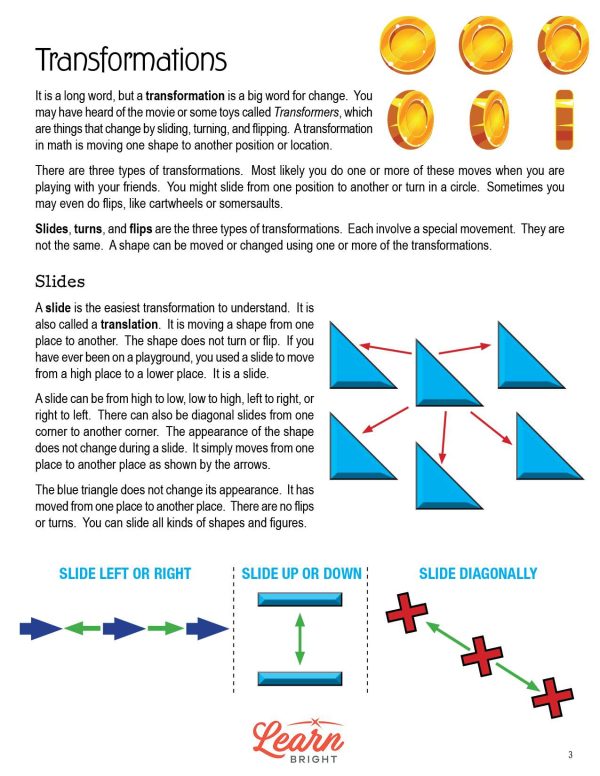
Slides (also called translations) are the easiest transformation. It just means moving a shape from one place to another without turning or flipping. Think of a slide on a playground!
Slides can go in any direction—up, down, left, right, or diagonal. In a slide, the appearance of the shape doesn’t change, it just moves from one place to another.
Turns
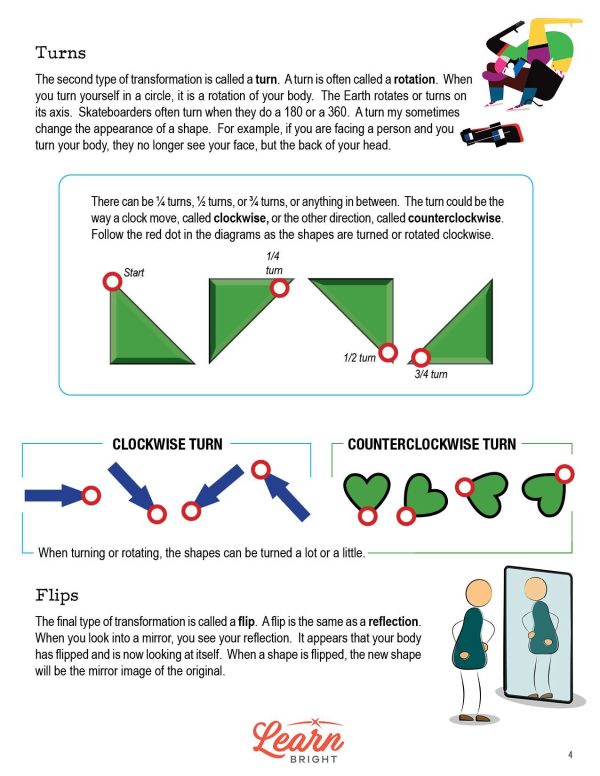
Turns (also called rotations) are the second type of transformation. If you turn yourself around in a circle, you’re rotating your body. The Earth rotates on its axis. Turns can sometimes change the appearance of a shape. For example, if you were facing someone and turned your body, they would see the back of your head instead of your face.
There are 1/4 turns, 1/2 turns, 3/4 turns, and many in between. If you turn something in the direction in which a clock moves, that’s a clockwise turn. If you turn it the opposite way, that’s a counterclockwise turn. You can turn a shape either a lot or only a little!
Flips
Flips (also called reflections) are the final type of transformation. If you look in a mirror, you’ll see your reflection. This makes it appear as though your body has flipped. Similarly, a shape that’s been flipped is the mirror image of the original.
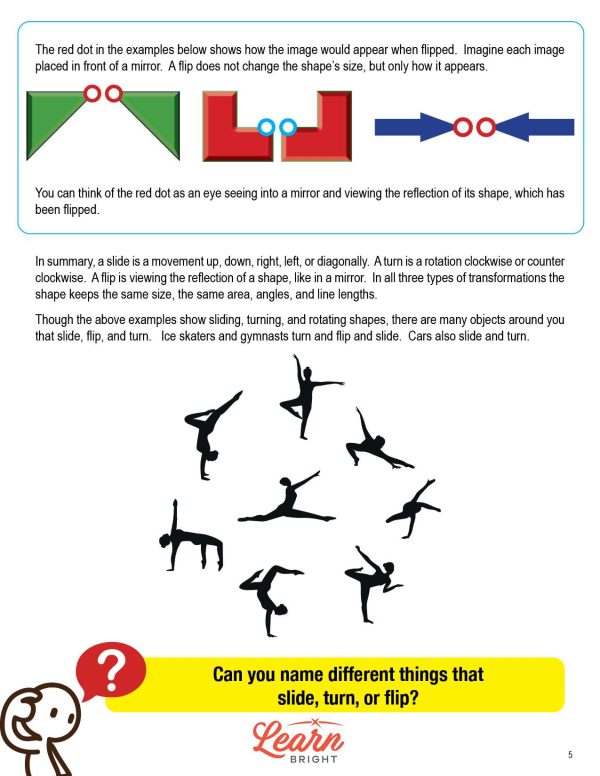
When flipping a shape, imagine it in front of a mirror. Flipping a shape doesn’t change the size of the shape, only the way it appears.
Summary
To summarize, slides are movements up, down, right, left, or diagonally; turns are rotations clockwise or counterclockwise; and flips are the reflection of a shape, like in a mirror. In all three types of transformation, shapes keep the same size, area, angles, and line lengths.
Many objects in your home or classroom can slide, flip, and turn!
SLIDES, TURNS, AND FLIPS LESSON PLAN WORKSHEETS
The Slides, Turns, and Flips lesson plan includes three worksheets: an activity worksheet, a practice worksheet, and a homework assignment. You can refer to the guide on the classroom procedure page to determine when to hand out each worksheet.
CUT AND PASTE ACTIVITY WORKSHEET
Students will work with a partner to complete the lesson activity. Each pair will first cut out the shapes on the worksheet. They will then move the shapes to practice sliding, turning, and flipping the figures. Next, they will glue the shapes onto construction paper, showing slides, turns, and flips. If they want, they can add a title and descriptions to their paper.
MATCHING PRACTICE WORKSHEET
For the practice worksheet, students will first match six terms from the lesson to their definitions. They will then look at pairs of shapes and determine whether each pair shows a slide, turn, or flip.
SLIDES, TURNS, AND FLIPS HOMEWORK ASSIGNMENT
The homework assignment asks students to first redraw each of the given shapes showing a slide, turn, and flip. Next, they will follow the instructions to draw different shapes in different orientations.
Worksheet Answer Keys
This lesson plan includes answer keys for the practice worksheet and the homework assignment. If you choose to administer the lesson pages to your students via PDF, you will need to save a new file that omits these pages. Otherwise, you can simply print out the applicable pages and keep these as reference for yourself when grading assignments.