


Description
What our Skip Counting Stories/Word Problems lesson plan includes
Lesson Objectives and Overview: Skip Counting Stories/Word Problems teaches students about skip counting and how it may need to be used when solving word problems. At the end of the lesson, students will be able to solve word problems that focus on skip counting with 5, 10, and 100. This lesson is for students in 2nd grade.
Classroom Procedure
Every lesson plan provides you with a classroom procedure page that outlines a step-by-step guide to follow. You do not have to follow the guide exactly. The guide helps you organize the lesson and details when to hand out worksheets. It also lists information in the blue box that you might find useful. You will find the lesson objectives, state standards, and number of class sessions the lesson should take to complete in this area. In addition, it describes the supplies you will need as well as what and how you need to prepare beforehand.
Options for Lesson
Included with this lesson is an “Options for Lesson” section that lists a number of suggestions for activities to add to the lesson or substitutions for the ones already in the lesson. One optional addition to this lesson is to have your students write their own word problems using items in the classroom such as desks, toes, fingers, or paperclips; next, have the whole class solve the problems as a group or make a worksheet of the problems for students to solve the next class.
Teacher Notes
The teacher notes page includes a paragraph with additional guidelines and things to think about as you begin to plan your lesson. This page also includes lines that you can use to add your own notes as you’re preparing for this lesson.
SKIP COUNTING STORIES/WORD PROBLEMS LESSON PLAN CONTENT PAGES
Skip Counting Stories/Word Problems
The Skip Counting Stories/Word Problems lesson plan includes two content pages. When you count by any number other than 1, you are skip counting! Skip counting can be a lot of fun and can make solving math problems much easier.
Skip Counting by 5
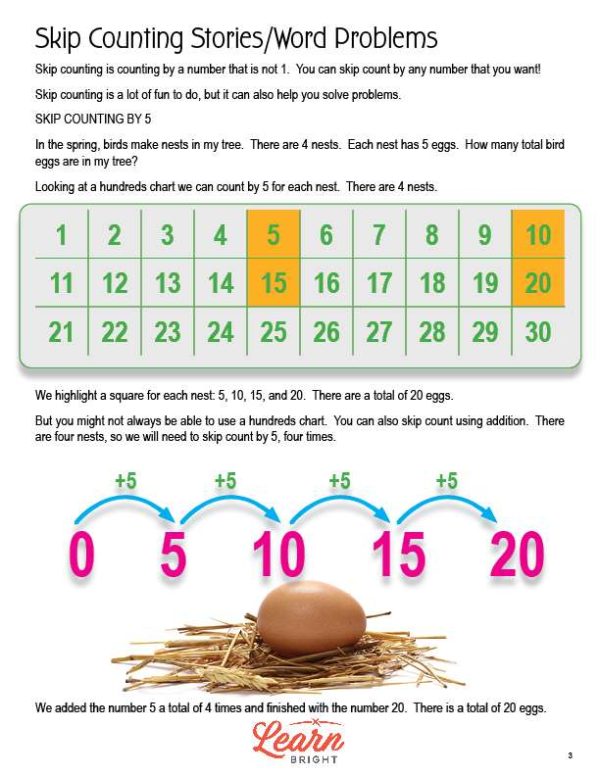
Let’s take a look at skip counting through a story. In the spring, birds make nests in a tree. This year, there are 4 nests and each nest has 5 eggs. How many bird eggs are in the tree?
To solve this problem, you can look at a hundreds chart and count by 5 for each nest. Since there are 4 nests, you count by 5s a total of 4 times. On the hundreds chart, you can highlight a square for each nest: 5, 10, 15, and 20. Therefore, there are 20 eggs in the tree.
However, it might not always make sense to use a hundreds chart. This is when skip counting using addition can come in handy. Since there are 4 nests, you skip count by 5 a total of 4 times. This is the same as adding the number 5 four times for a total of 20.
More Examples
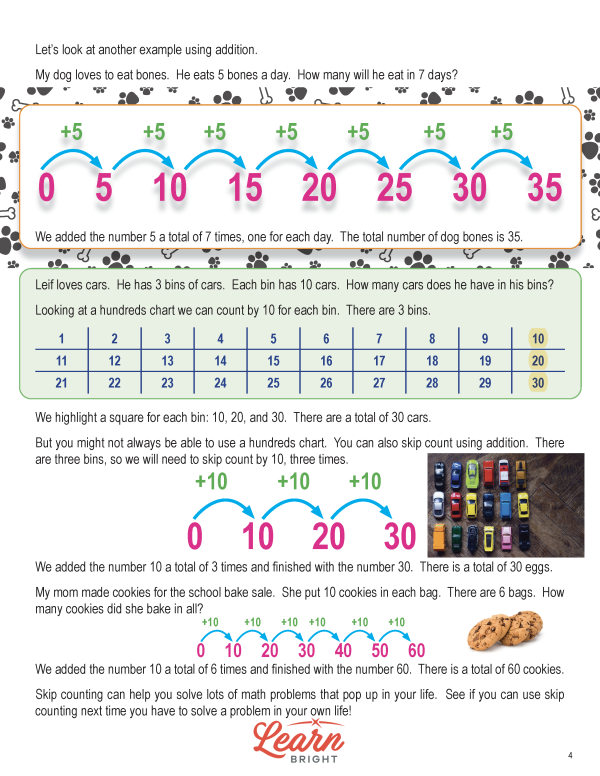
Let’s take a look at another example. A dog loves to eat bones and eats 5 bones a day. How many bones will he eat in 7 days? Using skip counting, you add the number 5 a total of 7 times, once for each day. Using this method, you discover that the total number of dog bones is 35.
Here’s another example: Leif loves cars. He has 3 bins of cars. Each bin has 10 cars. How many cars does he have in his bins? Looking at a hundreds chart, you can count by 10 a total of 3 times to get 30 bins. You can also solve this problem using skip counting instead of a hundreds chart, by skip counting by 10 three times. This is the same as adding the number 10 three times.
Let’s take a look at a final example. My mom made cookies for the school bake sale. She put 10 cookies in each bag. There are 6 bags. How many cookies did she bake in all? To solve using skip counting, you add the number 10 six times for a total of 60 cookies.
Skip counting is a great way to help you solve a variety of math problems. Try using skip counting to solve a problem in your real life!
SKIP COUNTING STORIES/WORD PROBLEMS LESSON PLAN WORKSHEETS
The Skip Counting Stories/Word Problems lesson plan includes three worksheets: an activity worksheet, a practice worksheet, and a homework assignment. You can refer to the guide on the classroom procedure page to determine when to hand out each worksheet.
NUMBER CARDS ACTIVITY WORKSHEET
Students will work with a partner to complete the lesson activity. Each pair is given a baggie with number cards inside and will begin by putting them in a line in order by counting 5, 10, and 100. Next, one partner will close their eyes while the other takes a random card out of the line. The first partner will open their eyes and try to figure out which card is missing from the pattern by counting by 5, 10, or 100. The partners will switch back and forth.
WORD PROBLEMS PRACTICE WORKSHEET
For the practice worksheet, students will solve eight word problems dealing with skip counting, making sure to show their work.
SKIP COUNTING STORIES/WORD PROBLEMS HOMEWORK ASSIGNMENT
The homework assignment asks students to fill in the blanks in three word problem stories and solve.
Worksheet Answer Keys
This lesson plan includes answer keys for the practice worksheet and the homework assignment. If you choose to administer the lesson pages to your students via PDF, you will need to save a new file that omits these pages. Otherwise, you can simply print out the applicable pages and keep these as reference for yourself when grading assignments.