

Description
What our Shapes and Attributes lesson plan includes
Lesson Objectives and Overview: Shapes and Attributes introduces students to a variety of shapes and classifies them based on different attributes. At the end of the lesson, students will be able to define shapes by their attributes, classify shapes in different categories, and identify shapes that do not belong in certain categories. This lesson is for students in 2nd grade, 3rd grade, and 4th grade.
Classroom Procedure
Every lesson plan provides you with a classroom procedure page that outlines a step-by-step guide to follow. You do not have to follow the guide exactly. The guide helps you organize the lesson and details when to hand out worksheets. It also lists information in the blue box that you might find useful. You will find the lesson objectives, state standards, and number of class sessions the lesson should take to complete in this area. In addition, it describes the supplies you will need as well as what and how you need to prepare beforehand. The supplies you will need for this lesson include scissors, colored pencils, construction paper, and the handouts.
Options for Lesson
Included with this lesson is an “Options for Lesson” section that lists a number of suggestions for activities to add to the lesson or substitutions for the ones already in the lesson. One optional addition to this lesson is to giving a manipulative to each of your students, announce attributes aloud, and have students with a manipulative matching that attribute move to that group. You could also bring your students on a tour of the school or take them outdoors, having them identify shapes and their attributes.
Teacher Notes
The teacher notes page includes a paragraph with additional guidelines and things to think about as you begin to plan your lesson. This page also includes lines that you can use to add your own notes as you’re preparing for this lesson.
SHAPES AND ATTRIBUTES LESSON PLAN CONTENT PAGES
Classifying and Organizing
The Shapes and Attributes lesson plan includes three content pages. You might organize the objects in your home or at school in a specific way. Maybe your pens are facing the same way or all of your socks are in the same drawer in your dresser.
Attributes are the characteristics that we use to classify or put things in certain groups. You can put the people in your class in groups based on things like hair color, shirt color, or simply by boys and girls. Objects can share the same attributes. We use these attributes to classify and organize these objects in different ways. For example, we could place pens and pencils in the same group as other writing tools, but we could not put a pen in a group with things made from wood.
In math and geometry, we organize and classify shapes based on their attributes. For shapes, there are two main groups: two-dimensional shapes (which have a length and width) and three-dimensional shapes (which have a length, width, and height). We can organize and categorize shapes using other characteristics as well!
Shapes and Attributes
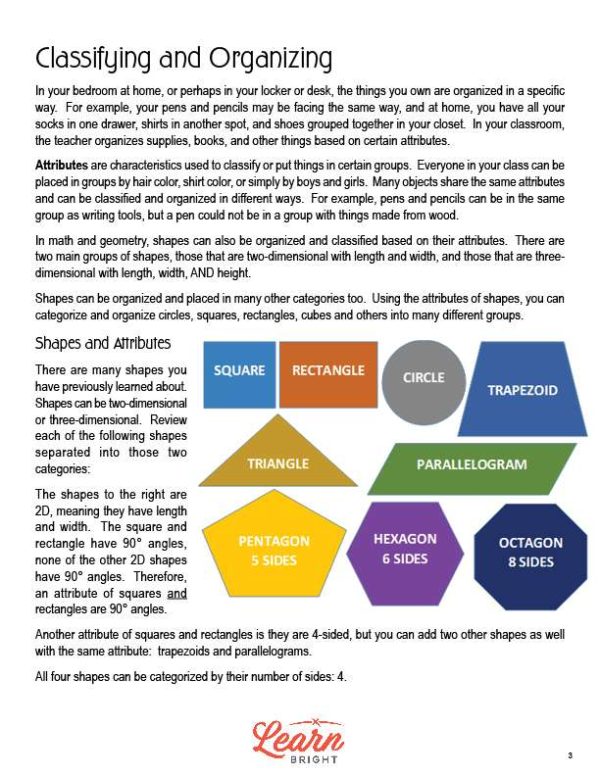
Shapes can be either two-dimensional or three-dimensional. Some two-dimensional (2D) shapes, which have a length and a width, include squares, rectangles, circles, trapezoids, triangles, parallelograms, pentagons, hexagons, and octagons. Squares and rectangles have 90° angles, but none of the other 2D shapes have 90° angles. Therefore, squares and rectangles share the attribute of having 90° angles. Squares and rectangles are also 4-sided, as are trapezoids and parallelograms. Therefore, we can categorize all four of these shapes by their number of sides (4).
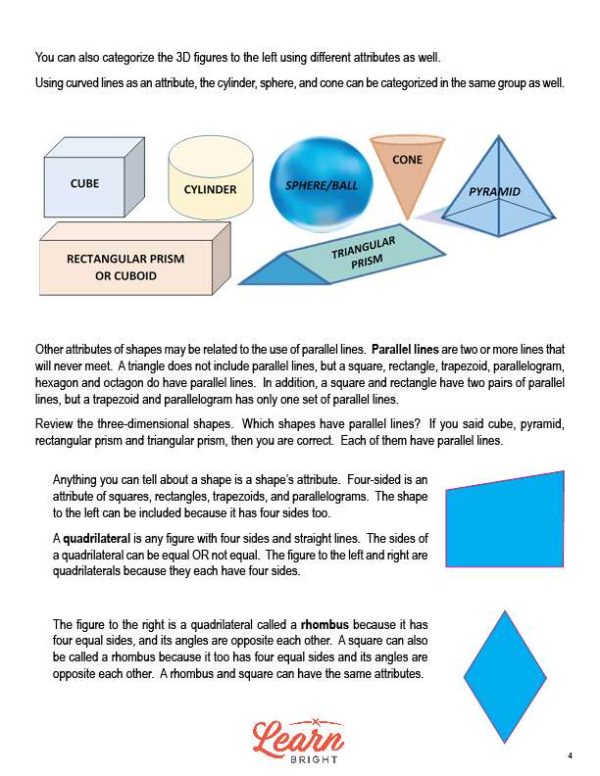
Some three-dimensional (3D) shapes, which have a length, width, and height, include cubes, cylinders, spheres/balls, cones, pyramids, rectangular prisms/cuboids, and triangular prisms. Using curved lines as an attribute, we can categorize cylinders, spheres, and cones in the same group.
A common attribute used to categorize shapes may be related to the number of parallel lines (two or more lines that will never meet). Triangles do not include parallel lines, but squares, rectangles, trapezoids, parallelograms, hexagons and octagons do. Additionally, squares and rectangles have two pairs of parallel lines, but trapezoids and parallelograms have only one set of parallel lines.
Try reviewing the three-dimensional shapes and asking which of them have parallel lines. The answer is the cube, pyramid, rectangular prism, and triangular prism. Each of them also has parallel lines!
We consider anything that you can tell about a shape is considered an attribute of that shape. Squares, rectangles, trapezoids, and parallelograms share the attribute of having four sides. The lesson includes a drawing of a quadrilateral, which can be included because it has four sides too. Quadrilaterals are any figures with four sides and straight lines. Their sides can be equal or not equal.
The lesson also includes a drawing of a rhombus, which has four equal sides and angles that are opposite each other. Squares are rhombi because they also have four equal sides and their angles are opposite each other. A rhombus and square can have some the same attributes! The lesson then shows three figures, all of which have four sides and equal opposite sides. However, only one of these shapes has one pair of parallel lines.
Learning how to identify shapes by their attributes is very important for solving geometry problems. Carpenters, engineers, architects, and many other people must use the attributes of shapes. Remember that all shapes have attributes and that we can categorize and organize into groups.
SHAPES AND ATTRIBUTES LESSON PLAN WORKSHEETS
The Shapes and Attributes lesson plan includes three worksheets: an activity worksheet, a practice worksheet, and a homework assignment. You can refer to the guide on the classroom procedure page to determine when to hand out each worksheet.
CUT OUTS ACTIVITY WORKSHEET
The activity worksheet asks students to cut apart the shapes on the worksheet. They will then write descriptions on each shape using the name of the shape and one or more the following words: parallel, angles, right angles, lines, opposite, straight, and curve. Once they’ve written their descriptions, they will glue or tap each shape to construction paper, decorating them as desired using colors and other pictures.
MATCHING PRACTICE WORKSHEET
For the practice worksheet, students will match the statement with the correct shape. Each shape may be used more than once.
SHAPES AND ATTRIBUTES HOMEWORK ASSIGNMENT
The homework assignment asks students to first match the definition with the correct term. They will also draw shapes based on their given descriptions.
Worksheet Answer Keys
This lesson plan includes answer keys for the practice worksheet and the homework assignment. If you choose to administer the lesson pages to your students via PDF, you will need to save a new file that omits these pages. Otherwise, you can simply print out the applicable pages and keep these as reference for yourself when grading assignments.