

Description
What our Alphabet: Letter Q lesson plan includes
Lesson Objectives and Overview: Alphabet: Letter Q teaches young learners about the seventeenth letter of the alphabet. By the end of the lesson, students will be able to recognize the uppercase and lowercase letter Q and name at least two words that begin with Q. This lesson is for students in preschool.
QUILTING TIME ACTIVITY
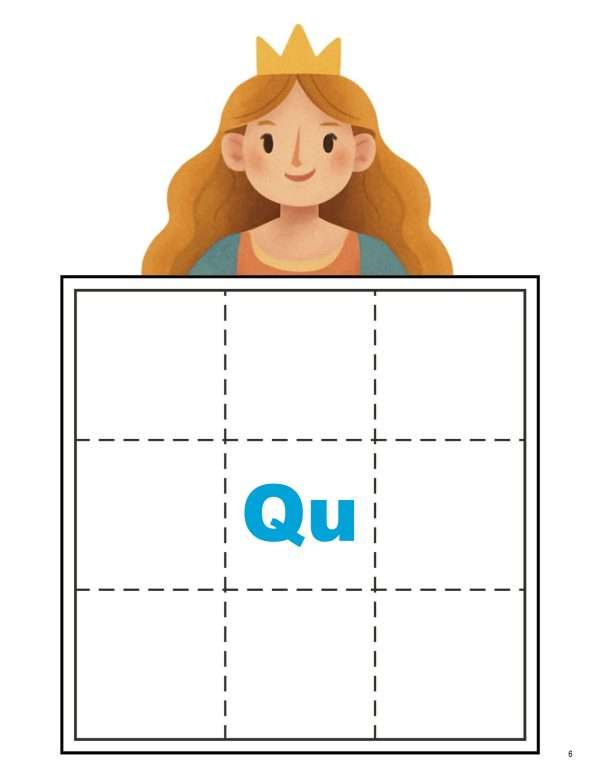
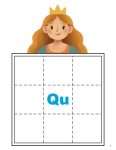
For the activity, students will create their own Qu quilt. Pass out the blank quilt papers. Have students trace the Q in the center of the quilt with their finger and then with a marker or crayon, if desired. Pass out felt, fabric scraps, or scrapbook paper cut into squares, as well as the glue. Show students how to glue each square together to form a patchwork quilt. Once students have completed their quilt, have them draw themselves (or someone else if they prefer) using the quilt at the top.
For some added fun, take pictures of the students pretending to sleep previous to the lesson. Print and cut out each student’s picture. Place each student under their quilt with their top half peeking out like they are using their quilt. Display the finished quilts in the classroom.
Options and Extensions
There are additional options you could add to the lesson. Let students be a queen/king for the day. Decorate a crown with words that start with Q. Make a quiet-time sensory box. Include items such as cotton balls, pom-poms, feathers, and soft blocks. Sing the song “Five Little Ducks Went out to Play.” Try singing it quietly but really emphasizing the “quack” part.
As an extension to the lesson, read The Quilt by Ann Jonas, The Kindness Quilt by Nancy Elizabeth Wallace*, and Be Quiet, Mike by Leslie Patricelli.
*This book can be a little long for preschoolers, but it has a great message. Try showing the pictures and summarizing the story instead.
ADDITIONAL RESOURCES
Our preschool lessons include additional resources that you can use throughout the lesson. They are provided to give you as much content as possible to complete the lesson without having to find sources on their own. For instance, if the lesson requires you to show students pictures, you can use the ones in the additional resources.
Preschool Philosophy
Our preschool curriculum is thoughtfully designed by professional teachers to nurture curiosity, build foundational skills, and prepare young learners for kindergarten and beyond. Each preschool lesson plan offers age-appropriate activities to promote early literacy, math readiness, creativity, and social-emotional growth.
At the preschool level, children are developing rapidly—socially, emotionally, physically, and academically. The goal of our lesson plans for preschool is to provide structured yet engaging learning experiences that spark imagination, encourage problem-solving, and foster a lifelong love of learning.
CURRICULUM FOCUS
Our curriculum focuses on key objectives such as:
- Building early literacy and language skills through stories, songs, and interactive activities.
- Developing number sense, shapes, colors, and patterns with hands-on lessons.
- Encouraging creativity and self-expression through art, play, and music.
- Supporting social-emotional development, cooperation, and confidence.
- Strengthening fine and gross motor skills through active learning.