

Description
What our Understanding Fractions lesson plan includes
Lesson Objectives and Overview: Understanding Fractions teaches students all about fractions, including what they are and how they are used in math. At the end of the lesson, students will be able to define and explain the concept of a fraction and add some proper fractions with the same denominators. This lesson is for students in 4th grade.
Classroom Procedure
Every lesson plan provides you with a classroom procedure page that outlines a step-by-step guide to follow. You do not have to follow the guide exactly. The guide helps you organize the lesson and details when to hand out worksheets. It also lists information in the blue box that you might find useful. You will find the lesson objectives, state standards, and number of class sessions the lesson should take to complete in this area. In addition, it describes the supplies you will need as well as what and how you need to prepare beforehand.
Options for Lesson
Included with this lesson is an “Options for Lesson” section that lists a number of suggestions for activities to add to the lesson or substitutions for the ones already in the lesson. One optional adjustment to the lesson activity is to have your students create their own title for the fraction poster. After the activity, you could have your students vote for best, most creative, colorful, and informative posters. An optional addition to this lesson is to use manipulatives during the lesson, having your students use them to demonstrate their understanding of fractions. Finally, you could have your students create a list of places, careers, and other uses for fractions in the real world.
Teacher Notes
The teacher notes page includes a paragraph with additional guidelines and things to think about as you begin to plan your lesson. This page also includes lines that you can use to add your own notes as you’re preparing for this lesson.
UNDERSTANDING FRACTIONS LESSON PLAN CONTENT PAGES
Understanding Fractions
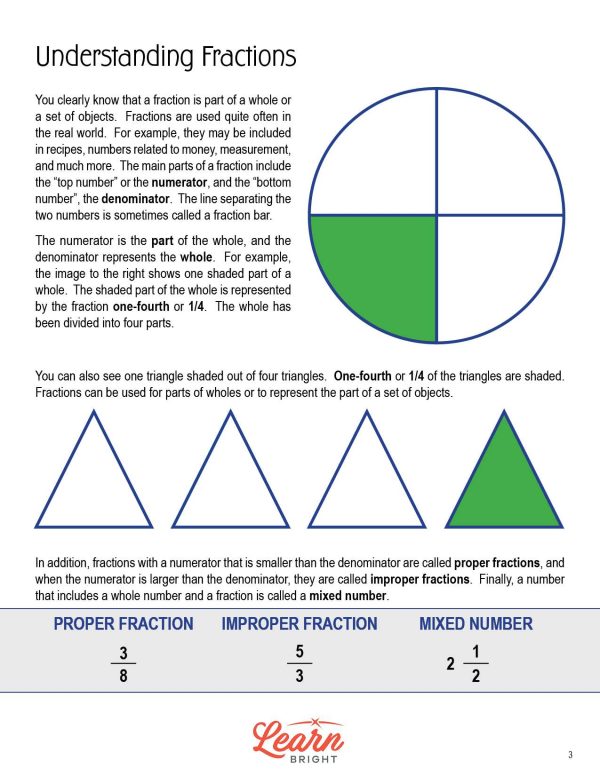
The Understanding Fractions lesson plan includes two content pages. Fractions are part of a whole or set of objects. We use fractions all the time in the real world! Recipes, numbers related to money, and measurements are just a few everyday things that include fractions. Fractions have three parts: a “top number” (numerator), a “bottom number” (denominator), and the line separating the two numbers (sometimes called a fraction bar).
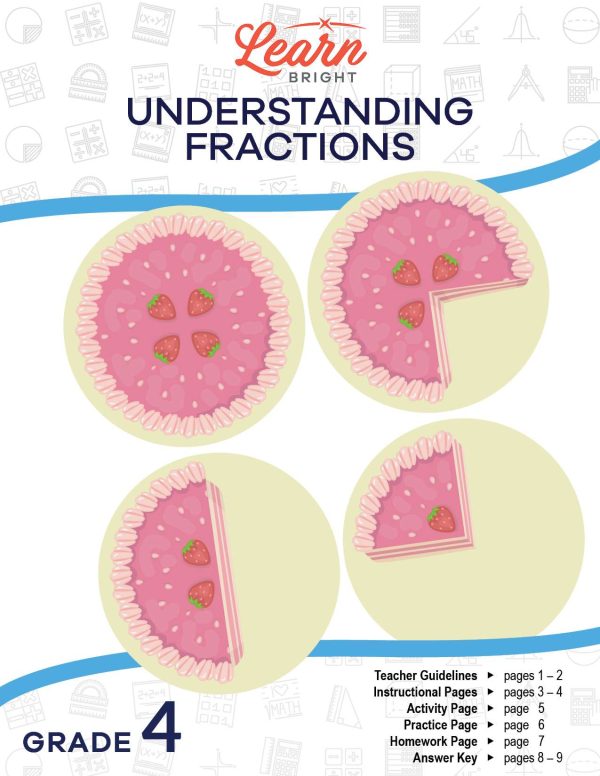
The numerator is a part of the whole, while the denominator represents the whole. For example, the lesson includes an image of a circle split into four parts with one shaded. We can represent the shaded part of the whole by the fraction one-fourth (1/4). One whole is divided into four parts.
The lesson also includes four triangles, with one shaded. One-fourth (1/4) of the triangles are shaded. We can use fractions to indicate parts of a whole, like the circle, or to represent a part of a set of multiple objects, like the triangles.
We have a few different kinds of fractions. Fractions with a smaller numerator than denominator are proper fractions, while fractions with a larger numerator than denominator are improper fractions. Numbers that includes both a whole number and a fraction are mixed numbers. Let’s look at an example of each type: 3/8 is a proper fraction, 5/3 is an improper fraction, and 2 1/2 is a mixed number.
Adding Fractions
We can add fractions together, just like whole numbers. Proper fractions with the same denominators are the easiest to add together—we simply add the numerators together to find the sum. For example, 3/5 + 1/5 = 3 + 1/5 = 4/5. The lesson includes a few other examples as well.
Let’s take another look at the same shaded circle from the beginning of the lesson. 1/4 of the circle is shaded, which means that 3/4 of the circle is not shaded. When you add these two fractions together, the sum is 4/4 or 1 whole!
In conclusion, fractions are parts of wholes which we can add or subtract just like whole numbers. The different kinds of fractions are proper, improper, and mixed numbers. Sometimes, we can change fractions into whole numbers. Understanding the different parts and kinds of fractions will help you add and subtract fractions just like you do with whole numbers!
UNDERSTANDING FRACTIONS LESSON PLAN WORKSHEETS
The Understanding Fractions lesson plan includes three worksheets: an activity worksheet, a practice worksheet, and a homework assignment. You can refer to the guide on the classroom procedure page to determine when to hand out each worksheet.
POSTER ACTIVITY WORKSHEET
Students will work with a partner to complete the lesson activity. Each pair will create a poster with the title “Everything You Wanted to Learn About Fractions but Were Afraid to Ask”. They will include all the information they can come up with about fractions, including explanations, drawings, and labels. Each pair can be creative with their poster design, including element such as bullet points, FAQs (Frequently Asked Questions) with responses, steps to add fractions, or any other strategies.
FRACTIONS PRACTICE WORKSHEET
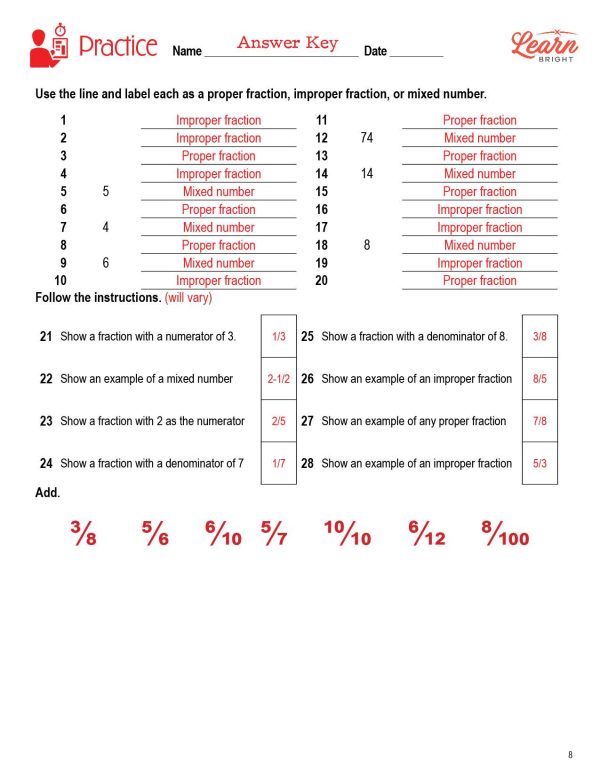
For the practice worksheet, students will label the 20 fractions listed on the worksheet as a proper fraction, improper fraction, or mixed number. They will then solve fraction problems with specific instructions, such as “Show a fraction with a numerator of 3.” Finally, they will add fractions together.
RECTANGLES HOMEWORK ASSIGNMENT
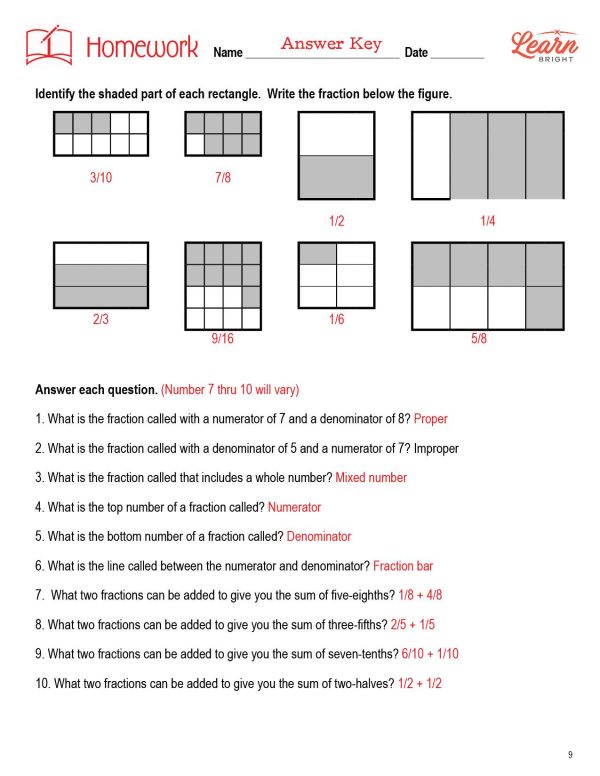
The homework assignment asks students to first identify the shaded part of each rectangle and write the fraction below the figure. They will also ten questions about fractions based on the lesson content.
Worksheet Answer Keys
This lesson plan includes answer keys for the practice worksheet and the homework assignment. If you choose to administer the lesson pages to your students via PDF, you will need to save a new file that omits these pages. Otherwise, you can simply print out the applicable pages and keep these as reference for yourself when grading assignments.