


Description
What our Triangles lesson plan includes
Lesson Objectives and Overview: Triangles prepares students to identify the four types of triangles and distinguish between each type. At the end of the lesson, students will be able to identify the four types of triangles and distinguish between each type. The students will be able to draw each type of triangle and recognize the types of triangles used for buildings and other structures and objects. This lesson is for students in 4th grade, 5th grade, and 6th grade.
Classroom Procedure
Every lesson plan provides you with a classroom procedure page that outlines a step-by-step guide to follow. You do not have to follow the guide exactly. The guide helps you organize the lesson and details when to hand out worksheets. It also lists information in the blue box that you might find useful. You will find the lesson objectives, state standards, and number of class sessions the lesson should take to complete in this area. In addition, it describes the supplies you will need as well as what and how you need to prepare beforehand.
Options for Lesson
Included with this lesson is an “Options for Lesson” section that lists a number of suggestions for activities to add to the lesson or substitutions for the ones already in the lesson. An optional adjustment to the lesson activity is to have your students create fewer than six drawings, combining the different triangle types in one to three drawings. You can also have students use toothpicks or craft sticks for the lesson activity instead of straws, and find their images in magazines or on the Internet instead of drawing them. One optional addition to the lesson is to invite an architect to speak to your students about the use of triangles in structures. You could also plan a bridge building contest using triangles made out of toothpicks, testing the strength of triangular bridges vs. rectangular bridges.
Teacher Notes
The teacher notes page includes a paragraph with additional guidelines and things to think about as you begin to plan your lesson. This page also includes lines that you can use to add your own notes as you’re preparing for this lesson.
TRIANGLES LESSON PLAN CONTENT PAGES
Triangles
The Triangles lesson plan includes two content pages. Adding a single diagonal line to many of the objects around you can create a triangle. Triangles are three-sided figures with three angles, which always add up to 180°. Architects use many triangles in their architectural designs for buildings, bridges, and other structures.
The three angles of a triangle always add up to 180°. The lesson shows a drawing of a rectangle with four 90° angles, which add up to a total of 360°. Drawing a diagonal line through the rectangle creates two triangles, each with 180°. In this way, triangles are half rectangles!
Mathematicians classify triangles using the length of their sides, their angle measurements, or both. Different types of triangles have different names. Some of these terms also describe angles (which are created by combining rays).
Construction workers and architects use triangles in construction because they are a much stronger shape than rectangles. Using triangles can even make a structure more resistant to earthquakes.
Types of Triangles
Triangles Classified by Length of the Sides
People classify triangles by the length of their sides. For every triangle, the total length when you add any two sides together is always greater than the length of the remaining side.
Equilateral triangles have three sides of the same length. Each of its angles equals 60°. An easy way to remember the word equilateral is to recognize that it contains “equi-,” which means equal, and “lateral,” which means sides. All sides and angles are equal!
Isosceles triangles have two equal sides and two equal angles. The equal angles cannot change. A way to remember the word isosceles is to recognize that the word has two e’s in it, which can refer to the e in equal sides and the e in equal angles.
Scalene triangles have no equal sides or angles. One way to remember the word scalene is to think of it as an odd word. The angles and sides in a scalene triangle are odd too!
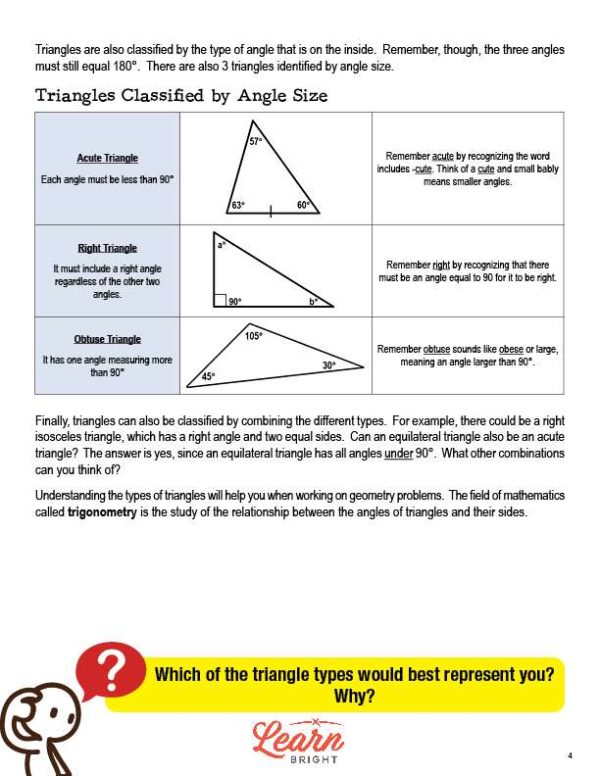
Triangles Classified by Angle Size
People also classify triangles by the type of angles they have. For every triangle, the three angles must equal 180°.
Acute triangles have three angles that measure less than 90°. One way to remember the word acute is to think of the word “cute” as part of the word acute. A cute triangle has small angles!
Right triangles have one right angle. The measurements of the other two angles vary. One way to remember right triangles is to think that a triangle must include an angle equal to 90° in order to be right.
Obtuse triangles have one angle that’s larger than 90°. A way to remember the word obtuse is that it sounds like obese, which means large.
Mathematicians also classify triangles using both length of the sides and angle size. For example, you can have a right isosceles triangle with one right angle and two equal sides. Equilateral triangles can also be an acute triangle, since all of its angles are under 90°. Try to think of some other combinations!
Understanding the different types of triangles is very helpful for solving geometry problems. Trigonometry, one field of mathematics, is the study of the relationship between a triangle’s angles and sides.
TRIANGLES LESSON PLAN WORKSHEETS
The Triangles lesson plan includes three worksheets: an activity worksheet, a practice worksheet, and a homework assignment. You can refer to the guide on the classroom procedure page to determine when to hand out each worksheet.
BUILDING STRUCTURES ACTIVITY WORKSHEET
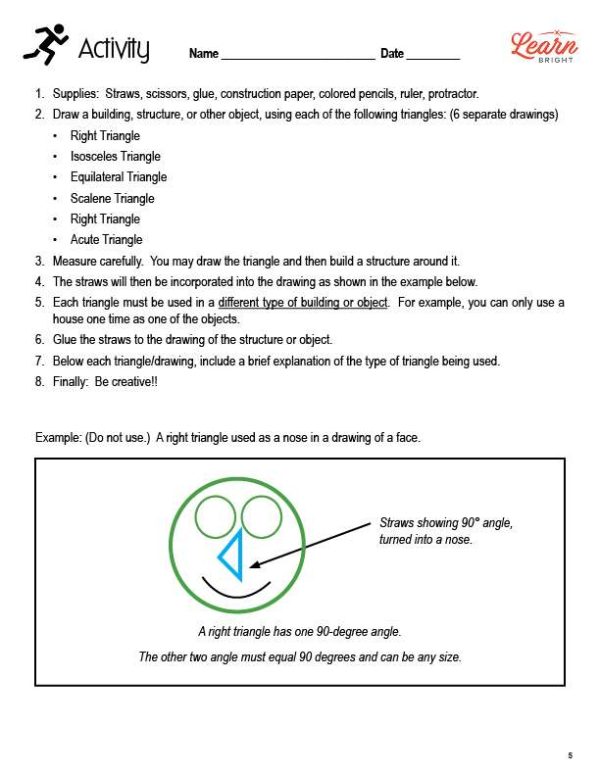
For the activity worksheet, students will draw six buildings, structures, or other objects, using each of the following triangles once: Right Triangle, Isosceles Triangle, Equilateral Triangle, Scalene Triangle, Right Triangle, and Acute Triangle. They will then build their structures using straws. They will also write down a brief explanation of the type of triangle used for each structure.
TRIANGLES PRACTICE WORKSHEET
The practice worksheet asks students to first identify the type of triangle based on each description given. Next, they will read the measurements of three angles and name the triangle it describes. Then, they will determine if five statements about triangles are true or false. Finally, they will look at triangles with two angle sizes given and write in the measurement of the third angle.
DRAWING TRIANGLES HOMEWORK ASSIGNMENT
For the homework assignment, students will take or draw pictures pictures of different triangles found in their home or neighborhood. They will then write a description of the object the triangle is a part of and the approximate measurements of each of the angles in the chart on the worksheet. Finally, they will draw each type of angle and label them.
Worksheet Answer Keys
This lesson plan includes answer keys for the practice worksheet and the homework assignment. If you choose to administer the lesson pages to your students via PDF, you will need to save a new file that omits these pages. Otherwise, you can simply print out the applicable pages and keep these as reference for yourself when grading assignments.