




Description
What our Subtract Fractions lesson plan includes
Lesson Objectives and Overview: Subtract Fractions teaches students how to subtract fractions with 10, 100, and 1000 as denominators. They will learn how to convert fractions to the proper denominator using a couple techniques. By the end of the lesson, they will be able to solve fractional problems with these denominators. This lesson is for students in 4th grade and 5th grade.
Classroom Procedure
Every lesson plan provides you with a classroom procedure page that outlines a step-by-step guide to follow. You do not have to follow the guide exactly. The guide helps you organize the lesson and details when to hand out worksheets. It also lists information in the blue box that you might find useful. You will find the lesson objectives, state standards, and number of class sessions the lesson should take to complete in this area. In addition, it describes the supplies you will need as well as what and how you need to prepare beforehand.
Options for Lesson
Included with this lesson is an “Options for Lesson” section that lists a number of suggestions for activities to add to the lesson or substitutions for the ones already in the lesson. One optional addition to this lesson is to have your students create their own Bump game boards with various questions. You could also have your students practice subtraction problems through an around the world game. If you have more advanced students, you can increase the number of place values or decrease and use decimals.
Teacher Notes
The teacher notes page includes lines that you can use to add your own notes as you’re preparing for this lesson.
SUBTRACT FRACTIONS LESSON PLAN CONTENT PAGES
Subtract Fractions with 10, 100, 1000 as Denominators
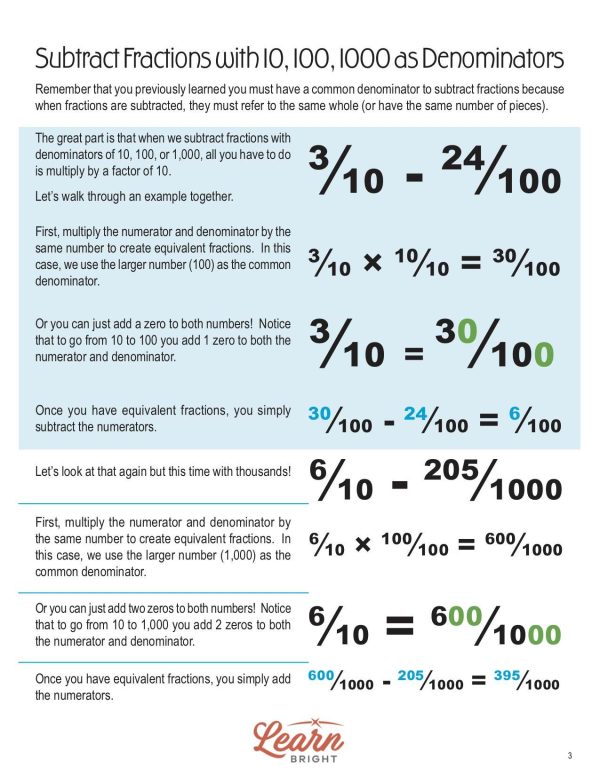
The Subtract Fractions lesson plan includes two content pages. Students should remember that you need a common denominator to subtract fractions, because fractions in subtraction problems must refer to the same whole. When working with subtractions with denominators of 10, 100, or 1,000, the only thing you need to do to create a common denominator is multiply by a factor of 10.
Example 1
Let’s take a look at an example: 3/10 – 24/100. First, multiply both the numerator and denominator by the same number to make the fractions equivalent. For this problem, the common denominator is 100, because it’s the larger number: 3/10 x 10/10 = 30/100.
Instead of multiplying, you could simply add a zero to both numbers to get the same fraction! Using this method, 3/10 becomes 30/100.
Now that you have equivalent fractions, simply subtract to solve: 30/100 – 24/100 = 6/100.
Example 2
Let’s look at an example with the thousands: 6/10 – 205/1000. Like before, the first step is to multiply both the numerator and denominator by the same number to make the fractions equivalent. The common denominator here is 1,000 because it’s the larger number: 6/10 x 100/100 = 600/1000.
Instead of multiplying, you could simply add two zeros to both numbers to get the same fraction: 6/100 = 600/1000.
Now that you have equivalent fractions, subtract the numerators to solve: 600/1000 – 205/1000 = 395/1000.
Example 3
Finally, let’s take a look at one more example: 82/100 – 350/1000. First, multiply both the numerator and denominator by the same number to make the fractions equivalent. The common denominator here is 1,000 because it’s the larger number: 82/100 x 10/10 = 820/1000.
Like before, instead of multiplying, you could simply add a zero to both numbers to get the same fraction: 82/100 = 820/1000.
Finally, subtract the numerators to solve: 820/1000 – 350/1000 = 470/1000.
SUBTRACT FRACTIONS LESSON PLAN WORKSHEETS
The Subtract Fractions lesson plan includes four worksheets: an activity worksheet, a practice worksheet, a homework assignment, and a quiz. You can refer to the guide on the classroom procedure page to determine when to hand out each worksheet.
BUMP GAME ACTIVITY
Students will work with a partner for the activity. The worksheet displays 11 boxes with various fraction equations. The 11 spaces correspond to the sum of two die. The first student will roll the die, and the second student will find the problem and solve it.
They will use a board with the numbers that correspond to the correct answers. They will also have counters that they can place on the appropriate numbers when they get it right. If the other person’s counter is on the space with the right number, they can bump it off and replace it with their own counter. If it has their own counter, they can place the second counter on that space. Then, if the other player gets that number, they cannot bump the other players’ counters. The game ends when all of one student’s counters are on the game board.
FILL IN THE TABLE PRACTICE WORKSHEET
The practice worksheet has two sections. The first section requires students to fill in the table with equivalent fractions. The second section requires them to convert fractions to the same denominator and then subtract the fractions.
CONVERT AND SUBTRACT HOMEWORK ASSIGNMENT
The homework assignment is similar to the practice worksheet. Students will fill in a table with equivalent fractions. Then they will convert fractions to the same denominator and subtract the fractions.
FRACTION SUBTRACTION QUIZ
For the quiz, students will solve two questions and show their work.
Worksheet Answer Keys
This lesson plan includes answer keys for the practice worksheet, the homework assignment, and the quiz. If you choose to administer the lesson pages to your students via PDF, you will need to save a new file that omits these pages. Otherwise, you can simply print out the applicable pages and keep these as reference for yourself when grading assignments.


