




Description
What our Solving Word Problems lesson plan includes
Lesson Objectives and Overview: Solving Word Problems strengthens strategies for solving word problems. This interactive lesson plan equips students to identify and define keywords and use pictures or diagrams for math problem solving (all operations). At the end of the lesson, students will be able to identify and define keywords and use pictures or diagrams for math problem solving (all operations). This lesson is for students in 3rd grade, 4th grade, and 5th grade.
Classroom Procedure
Every lesson plan provides you with a classroom procedure page that outlines a step-by-step guide to follow. You do not have to follow the guide exactly. The guide helps you organize the lesson and details when to hand out worksheets. It also lists information in the blue box that you might find useful. You will find the lesson objectives, state standards, and number of class sessions the lesson should take to complete in this area. In addition, it describes the supplies you will need as well as what and how you need to prepare beforehand.
Options for Lesson
Included with this lesson is an “Options for Lesson” section that lists a number of suggestions for activities to add to the lesson or substitutions for the ones already in the lesson. One optional addition to this lesson is to assign your students additional word problems to create from scratch for other students to solve; you could then use a single word problem from each student, compile them, and create a test. For additional practice, you could give your students more word problems for in-class solving and for homework. Finally, you could have your students make a large chart for classroom display showing the keywords for each operation.
Teacher Notes
The teacher notes page includes a paragraph with additional guidelines and things to think about as you begin to plan your lesson. This page also includes lines that you can use to add your own notes as you’re preparing for this lesson.
SOLVING WORD PROBLEMS LESSON PLAN CONTENT PAGES
Solving Word Problems
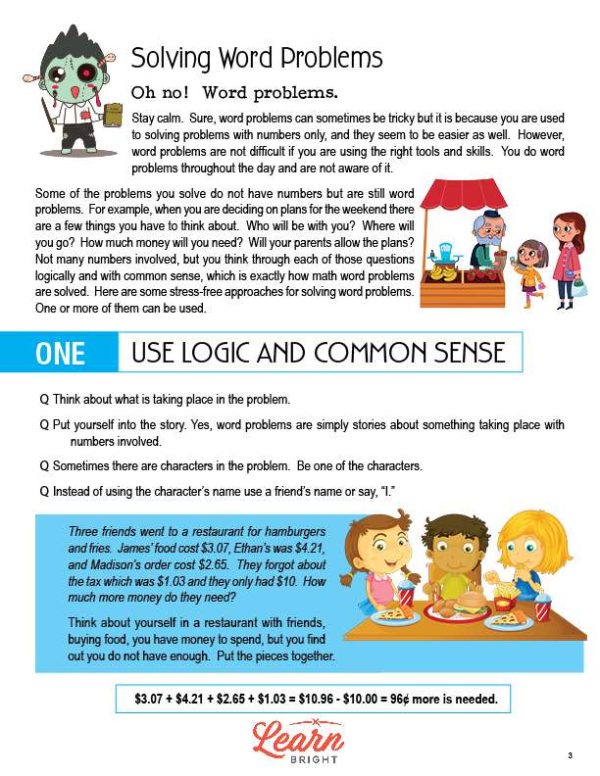
The Solving Word Problems lesson plan includes three content pages. Word problems can be intimidating because many math problems use only numbers. However, with the right tools and methods, word problems aren’t that difficult. People solve word problems all the time in their day-to-day lives without even realizing it.
Some word problems include numbers. For example, think about how you decide on your plans for the weekend. Who will be with you? Where will you go? How much money will you need? Will your parents allow the plans? This problem doesn’t include many numbers, but you think through each of those questions logically and with common sense. This is exactly how you solve math word problems! Let’s take a look at a few approaches to solving word problems.
One: Use Logic and Common Sense
The first method is to use logic and common sense. First, think about what is taking place in the problem. Next, try putting yourself into the story, since word problems are simply stories that include numbers. Imagine yourself as one of the characters in the story.
Let’s take a look at an example problem: Three friends went to a restaurant for hamburgers and fries. James’ food cost $3.07, Ethan’s was $4.21, and Madison’s order cost $2.65. They forgot about the tax which was $1.03 and they only had $10. How much more money do they need?
To solve this problem, picture yourself in the restaurant with your friends. Then put the pieces together: $3.07 + $4.21 + $2.65 + $1.03 = $10.96 – $10.00 = 96¢ more is needed.
Two: Draw a Picture or Diagram
The second method is to draw a picture or diagram. Break the problem down into pictures, which could be simple sketches. Draw it in a way that you understand. You could try using a diagram to show a distribution of something.
Let’s take a look at an example problem and how to solve it using this method: There are four jars of candy on the teacher’s desk. Each jar has 125 pieces. The teacher wants 3 students to share each jar. If each student gets the same amount from each jar, how many pieces will be left over?
Draw a picture or diagram to help you solve this problem. Your picture might be a drawing of the four jars with the number 125 on each of them. Looking at this picture, you can figure out that you first need to divide each jar by 3. This leaves 41 pieces for each student with 2 pieces left over from each jar, which is 4 x 2 = 8 pieces total left over.
Three: Identify Keywords
The third method is to identify keywords which tell you to add, subtract, multiply, or divide. You can combine this method with one of the other methods above. To use this method, circle or underline the keywords in the problem. Be careful! Just because you see a keyword doesn’t mean you should automatically use that operation. Use common sense!
Let’s take a look at an example: In the month of April, which has 30 days, Taylor spent about two hours texting each day to friends, 1.5 hours each day doing homework, and additional 90 hours using the computer. How many more hours did Taylor text than do homework? How many total hours did Taylor text and use the computer? What was the average number of hours per day Taylor used the computer? How many total hours are accounted for in April for Taylor?
The keyword in this problem include each, additional, many more, total, average, and per. In this case, you must use all four operations to solve the problem!
Final Thing to Think About
When solving word problems, don’t rush! Take your time and read the problem more than once if you need to. Try combining two or more methods to solve the problem. Some problems will have either too much or not enough information.
Once you come to a solution for a problem, ask yourself a few questions: Does the solution make sense? Is the answer logical? Have I found what the question asked for?
Like with most things, practice makes perfect! The more word problems you solve, the easier they will become. Don’t give up and use one or more of the methods until you find the one that works for you.
SOLVING WORD PROBLEMS LESSON PLAN WORKSHEETS
The Solving Word Problems lesson plan includes four worksheets: two activity worksheets, a practice worksheet, and a homework assignment. You can refer to the guide on the classroom procedure page to determine when to hand out each worksheet.
CREATING WORD PROBLEMS ACTIVITY WORKSHEET
Students will work with a partner to complete the lesson activity. Each pair will create five word problems using the information shown on the worksheet. They will follow the rules on the worksheet to create their problems. Once they complete their problems, they will exchange them with another pair of students to solve.
LESSON CLOSING ACTIVITY WORKSHEET
For the lesson closing activity worksheet, students will shade keywords for different operations in different colors. For example, they will shade all addition keywords blue and all subtraction keywords green.
METHODS PRACTICE WORKSHEET
For the practice worksheet, students will solve word problems using the method shown (use logic and common sense, draw a picture or diagram, and identify keywords).
SOLVING WORD PROBLEMS HOMEWORK ASSIGNMENT
The homework assignment asks students to solve four word problems. They will solve the problems mathematically and write in words how to solve them.
Worksheet Answer Keys
This lesson plan includes answer keys for the activity worksheet, the practice worksheet, and the homework assignment. If you choose to administer the lesson pages to your students via PDF, you will need to save a new file that omits these pages. Otherwise, you can simply print out the applicable pages and keep these as reference for yourself when grading assignments.


