





Description
What our Simple Interest lesson plan includes
Lesson Objectives and Overview: Simple Interest introduces students to the concept of simple interest. At the end of the lesson, students will be able to calculate simple interest given the principal, rate, and time of a loan or purchase, as well as define each of the terms. This lesson is for students in 5th grade and 6th grade.
Classroom Procedure
Every lesson plan provides you with a classroom procedure page that outlines a step-by-step guide to follow. You do not have to follow the guide exactly. The guide helps you organize the lesson and details when to hand out worksheets. It also lists information in the blue box that you might find useful. You will find the lesson objectives, state standards, and number of class sessions the lesson should take to complete in this area. In addition, it describes the supplies you will need as well as what and how you need to prepare beforehand.
Options for Lesson
Included with this lesson is an “Options for Lesson” section that lists a number of suggestions for activities to add to the lesson or substitutions for the ones already in the lesson. One optional addition to this lesson is to let your students use Internet access to find interest rates for various banks, credit cards, or loan companies. Another optional addition to this lesson is to invite a banker to discuss loans and interest with your class. You could also show videos of banks, car dealers, or other lenders and their commercials for borrowing money or purchasing a car. You could allow your students to use calculators throughout the lesson. Finally, if you have more advanced students, you can also have them solve for principal, time, or rate.
Teacher Notes
The teacher notes page includes a paragraph with additional guidelines and things to think about as you begin to plan your lesson. This page also includes lines that you can use to add your own notes as you’re preparing for this lesson.
SIMPLE INTEREST LESSON PLAN CONTENT PAGES
Simple Interest
The Simple Interest lesson plan includes two content pages. Have you ever wanted to buy something only to realize you couldn’t afford it because of the tax? The percent of tax added to purchases is similar to an interest rate, because it’s a percent you pay above the cost of the product. Interest is the amount of money you need to pay in order to borrow money.
Businesses that lend money often use simple interest. The amount of interest someone needs to pay depends on a few different factors. However, no matter what, the method for calculating the amount of interest stays the same.
Let’s look at some terms related to interest. The borrower is the person borrowing the money from a bank or other lender. The principal is the amount of money borrowed (also called the loan amount). Interest is the total cost of borrowing the money. The rate, shown as a percentage, is the percent of interest added to the principal, and changes depending on the lender. Finally, time is the length of the loan, often shown in years; this is how long it will take to pay back the loan.
Simple Interest Formula
The formula for calculating simple interest is Interest = Principal x Rate x Time or I = Prt.
Let’s say you want to borrow $50 from a friend. That $50 is the principal. Your friend charges you a rate of 5% to borrow the money, and you agree to pay him back in 2 years. 2 years is the time. Now that you have the principal, rate, and time, you can calculate the interest and determine how much it will cost you to borrow this money from your friend. Interest = $50 x 5% x 2 years. Remember to change the percent to a decimal before multiplying! When you use the formula, you can see that your total amount of interest is $5. Therefore, you will need to pay your friend a total of $55.
Let’s look at how the time affects the total amount of interest. For this example, if you borrowed the money for 1 year instead of 2, the interest would be $2.50. If you borrowed the money for 4 years, the interest would be $10.00. The longer you borrow money, the higher the cost. The rate of interest also affects your total cost. A higher rate means more interest.
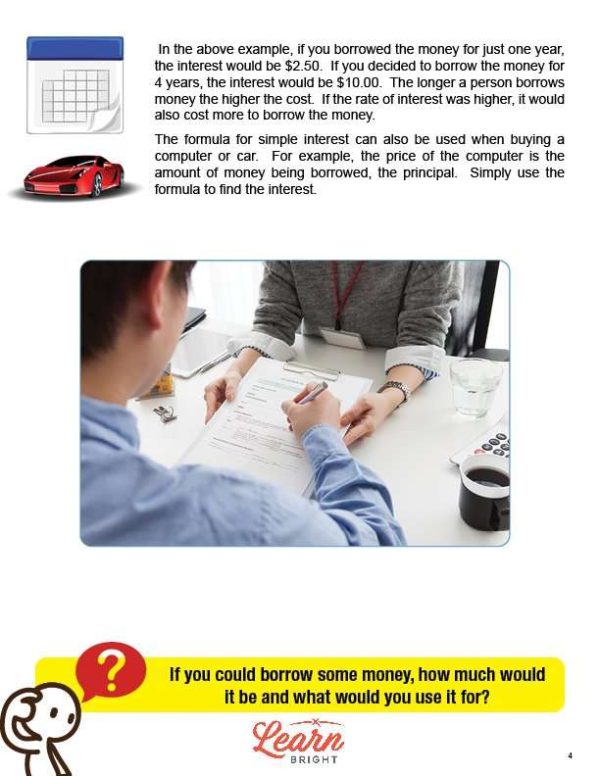
You might use the formula for simple interest when buying a computer or car. For example, the price of the computer is the amount of money being borrowed (the principal). You can then use the formula to find the interest!
SIMPLE INTEREST LESSON PLAN WORKSHEETS
The Simple Interest lesson plan includes three worksheets: an activity worksheet, a practice worksheet, and a homework assignment. You can refer to the guide on the classroom procedure page to determine when to hand out each worksheet.
PRINCIPAL, RATE, TIME ACTIVITY WORKSHEET
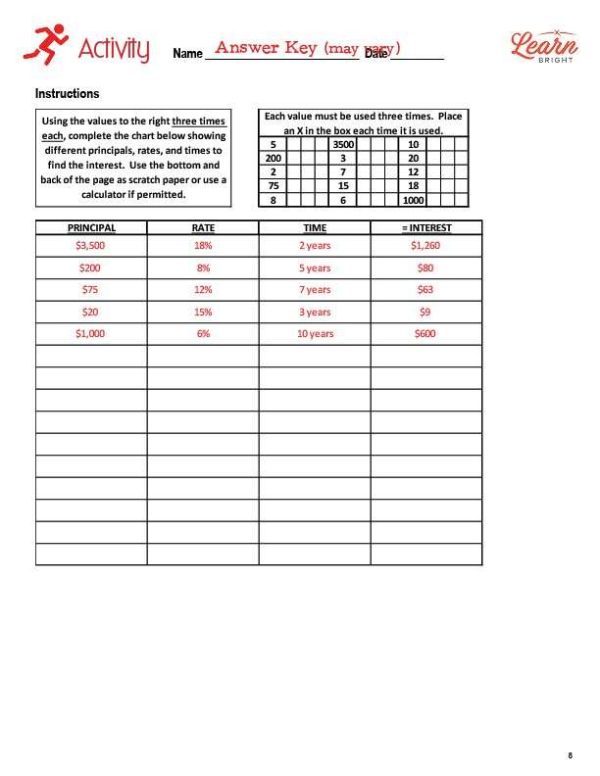
For the activity worksheet, students will use the values listed on the worksheet to complete the chart showing different principals, rates, and times to find the interest. They will use each value three times each. Students can use the bottom and back of the page as scratch paper or use a calculator if permitted.
WORD PROBLEMS PRACTICE WORKSHEET
The practice worksheet asks students to solve six word problems related to simple interest.
SIMPLE INTEREST HOMEWORK ASSIGNMENT
For the homework assignment, students will complete the chart on the worksheet using information from newspapers, TV Ads, magazines, or on-line websites. The chart includes the principal, rate, time, and interest. Students will also ask three adults who may have borrowed money or purchased a product a few questions about the purchase. They will then calculate the interest paid and total amount paid based on their answers.
Worksheet Answer Keys
This lesson plan includes answer keys for the activity worksheet, the practice worksheet, and the homework assignment. If you choose to administer the lesson pages to your students via PDF, you will need to save a new file that omits these pages. Otherwise, you can simply print out the applicable pages and keep these as reference for yourself when grading assignments.


