




Description
What our Simple Equivalent Fractions lesson plan includes
Lesson Objectives and Overview: Simple Equivalent Fractions teaches students the basics of equivalent fractions and how to recognize them. At the end of the lesson, students will be able to recognize and create simple equivalent fractions. This lesson is for students in 3rd grade.
Classroom Procedure
Every lesson plan provides you with a classroom procedure page that outlines a step-by-step guide to follow. You do not have to follow the guide exactly. The guide helps you organize the lesson and details when to hand out worksheets. It also lists information in the blue box that you might find useful. You will find the lesson objectives, state standards, and number of class sessions the lesson should take to complete in this area. In addition, it describes the supplies you will need as well as what and how you need to prepare beforehand.
Options for Lesson
Included with this lesson is an “Options for Lesson” section that lists a number of suggestions for activities to add to the lesson or substitutions for the ones already in the lesson. Both of the suggestions for this lesson relate to the lesson activity. First, you can have your students create their own set of equivalent fraction plates and then mix them up and hide them around the room. Second, if it’s not too windy, you could take this lesson outside and have students dance around and use some energy.
Teacher Notes
The teacher notes page includes a paragraph with additional guidelines and things to think about as you begin to plan your lesson. This page also includes lines that you can use to add your own notes as you’re preparing for this lesson.
SIMPLE EQUIVALENT FRACTIONS LESSON PLAN CONTENT PAGES
Simple Equivalent Fractions
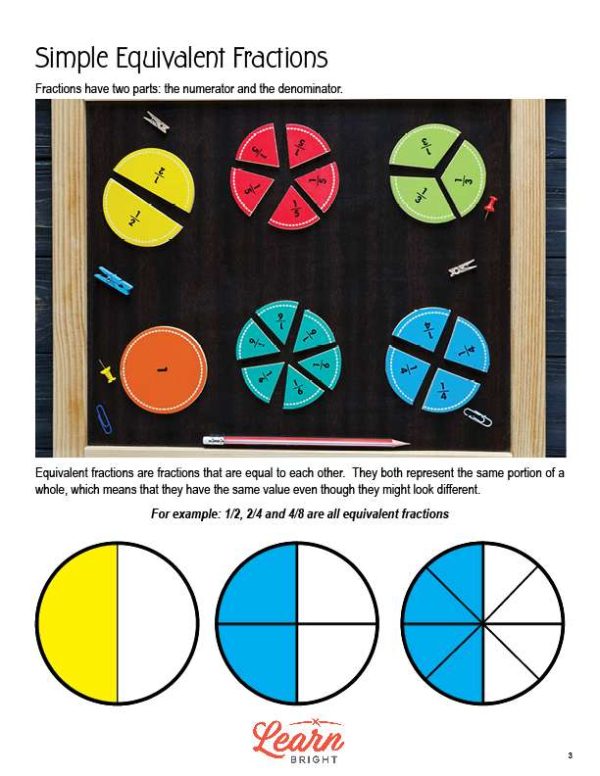
The Simple Equivalent Fractions lesson plan includes two content pages. Fractions have two parts, the numerator and the denominator. Equivalent fractions are equal fractions, which means they represent the same portion of a whole. They have the same value even if they look different. For example, 1/2, 2/4 and 4/8 are all equivalent fractions.
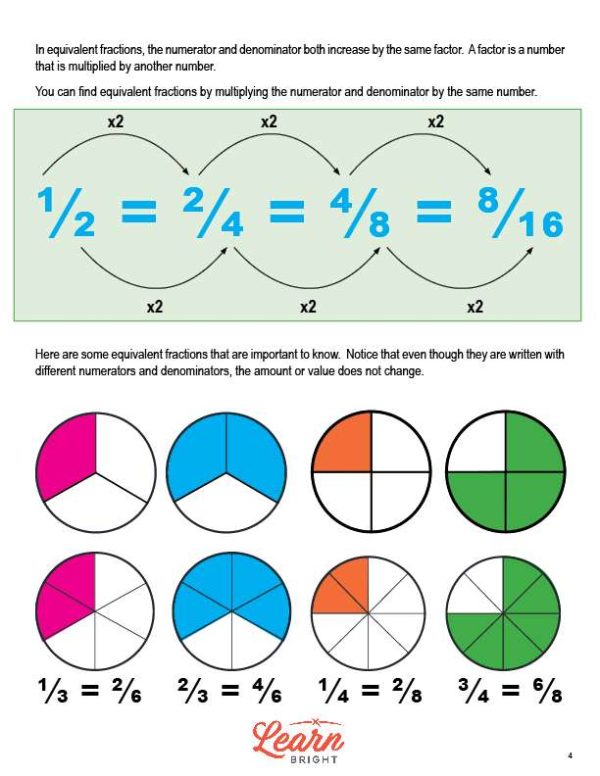
With equivalent fractions, both the numerator and denominator increase by the same factor (a number multiplied by another number). To find equivalent fractions, multiply the numerator and denominator by the same number.
Let’s look at some more equivalent fractions! 1/3 = 2/6, 2/3 = 4/6, 1/4 = 2/8, and 3/4 = 6/8.
SIMPLE EQUIVALENT FRACTIONS LESSON PLAN WORKSHEETS
The Simple Equivalent Fractions lesson plan includes three worksheets: an activity worksheet, a practice worksheet, and a homework assignment. You can refer to the guide on the classroom procedure page to determine when to hand out each worksheet.
MUSIC HUNT ACTIVITY WORKSHEET
For the activity worksheet, students will first receive a fraction written on a sticky note, which they will remember and stick to their shirt. Next, students will find the paper plate with an equivalent fraction written on it somewhere in the classroom. The teacher will start some music, and the students will dance to the music while trying to find their equivalent fraction plate. When they find it, they’ll stand on it. If they don’t find it before the music stops, they’re out of the game! This continues until they find all of the fractions that are equivalent to their own.
MODELS PRACTICE WORKSHEET
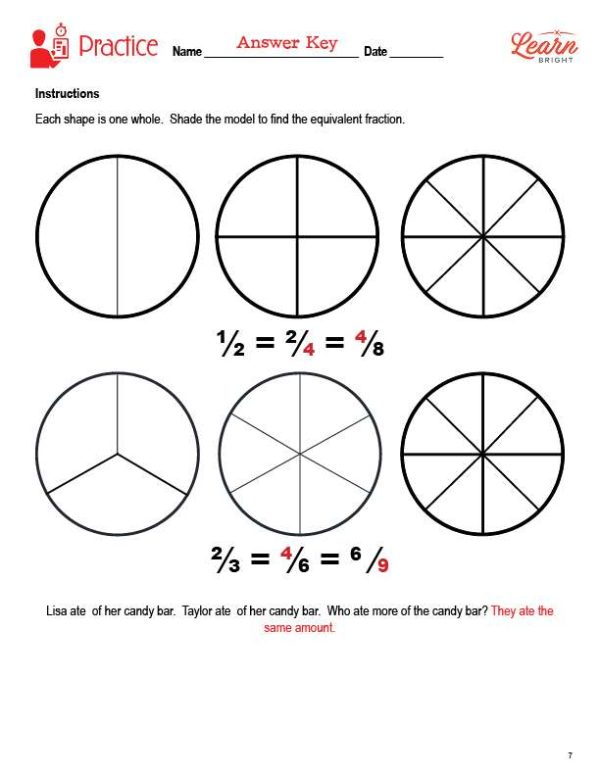
For the practice worksheet, students will shade models of shapes to find the equivalent fraction.
SIMPLE EQUIVALENT FRACTIONS HOMEWORK ASSIGNMENT
The homework assignment asks students to first write two sets of equivalent fractions. They will then tell and show how they know the fractions are equivalent, using pictures.
Worksheet Answer Keys
This lesson plan includes an answer key for the practice worksheet. If you choose to administer the lesson pages to your students via PDF, you will need to save a new file that omits these pages. Otherwise, you can simply print out the applicable pages and keep these as reference for yourself when grading assignments.


