




Description
What our Scientific Notation lesson plan includes
Lesson Objectives and Overview: Scientific Notation teaches students about scientific notation, including what it is and how to use it in mathematics. At the end of the lesson, students will be able to define and use scientific notation for large whole numbers and decimals using positive and negative exponents. This lesson is for students in 6th grade.
Classroom Procedure
Every lesson plan provides you with a classroom procedure page that outlines a step-by-step guide to follow. You do not have to follow the guide exactly. The guide helps you organize the lesson and details when to hand out worksheets. It also lists information in the blue box that you might find useful. You will find the lesson objectives, state standards, and number of class sessions the lesson should take to complete in this area. In addition, it describes the supplies you will need as well as what and how you need to prepare beforehand.
Options for Lesson
Included with this lesson is an “Options for Lesson” section that lists a number of suggestions for activities to add to the lesson or substitutions for the ones already in the lesson. One optional adjustment to the lesson activity is to have your students simply change the planet distances to scientific notation instead of creating a poster. For an additional activity, you could have your students use the Internet to research other very large or small numbers to change into scientific notation or write the standard form of numbers found using scientific notation. Finally, you could have your students create a matching worksheet for each other that includes one column with standard form and a second column with scientific notation.
Teacher Notes
The teacher notes page includes a paragraph with additional guidelines and things to think about as you begin to plan your lesson. This page also includes lines that you can use to add your own notes as you’re preparing for this lesson.
SCIENTIFIC NOTATION LESSON PLAN CONTENT PAGES
Exponents
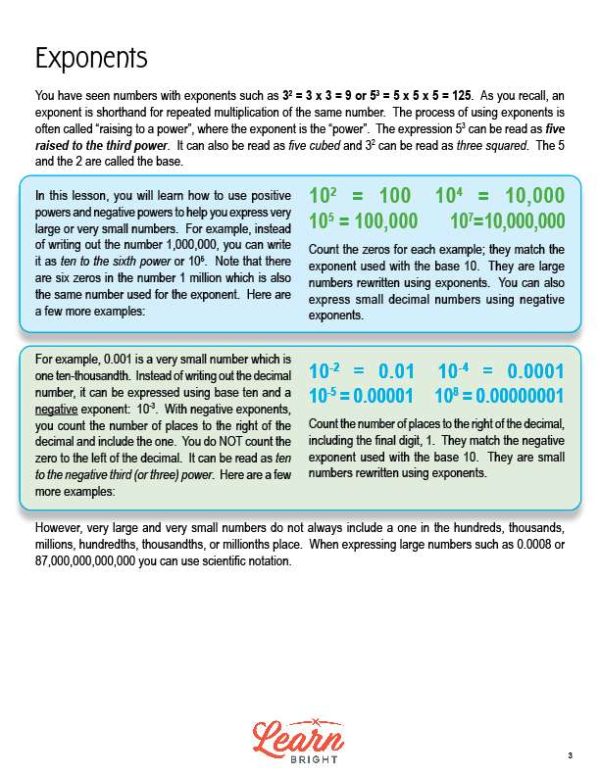
The Scientific Notation lesson plan includes three content pages. Exponents are a form of shorthand for repeated multiplication of the same number (for example, 3² = 3 x 3 = 9 or 5³ = 5 x 5 x 5 = 125).
Using exponents is also called “raising to a power,” where the exponent is the “power.” For example, you can read the expression 5³ as five raised to the third power or five cubed, and you can read 3² as three squared. In these examples, 5 and 3 are the base.
Positive and negative powers can express very large or very small numbers. For example, you can write the number 1,000,000 as ten to the sixth power or 10⁶ instead. The number one million has six zeroes, which is the number used for the exponent.
Let’s take a look at a few more examples: 10² = 100, 10⁴ = 10,000, 10⁵ = 100,000, and 10⁷ = 10,000,000. Like the earlier examples, the number of zeroes match the exponent used with the base of 10. These examples are all larger numbers rewritten with exponents.
Negative Exponents
You can also express small decimal numbers using negative exponents. Let’s take a look at a few examples using negative exponents. 0.001, or one ten-thousandth, is a very small number that you can express using base ten and a negative exponent: 10⁻³. When using negative exponents, count the places to the right of the decimal, including the one. Make sure not to count the zero to the left of the decimal. You can read 10⁻³ as ten to the negative third (or three) power.
Let’s take a look at a few more examples. 10⁻² = 0.01, 10⁻⁴ = 0.0001, 10⁻⁵ = 0.00001, and 10⁻⁸ = 0.00000001. The number of places to the right of the decimal matches the negative exponent used with the base of 10. These examples are all small numbers rewritten with exponents.
However, not all very large and very small numbers include a one in the hundreds, thousands, millions, hundredths, thousandths, or millionths place. To express large numbers such as 0.0008 or 87,000,000,000,000, you can use scientific notation.
Scientific Notation
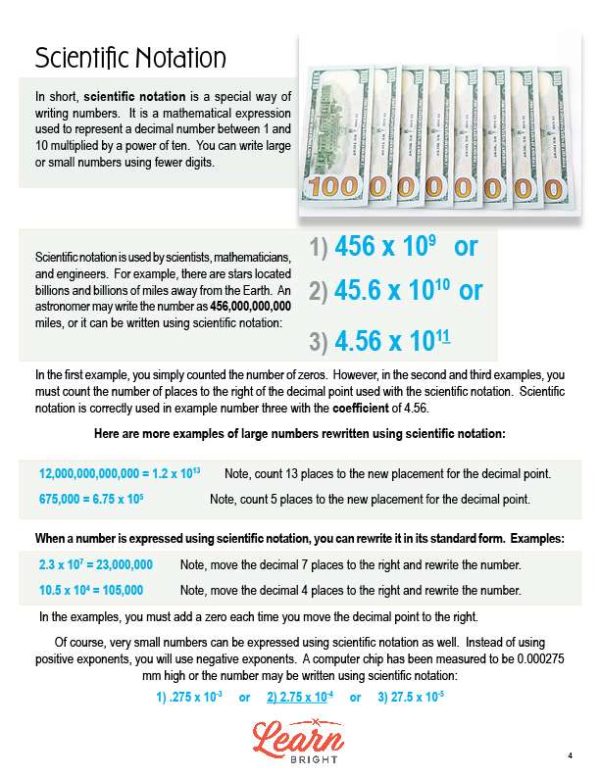
Scientific notation is a specific way to write numbers. It is also a mathematical expression that represents decimal numbers between 1 and 10 multiplied by a power of ten. It’s a way to write large or small numbers using fewer digits.
Scientists, mathematicians, and engineers use scientific notation in their work. For example, some stars are located billions and billions of miles away from the Earth, and an astronomer might write that distance as 456,000,000,000 miles, or they can write it using scientific notation.
Let’s look at a few ways someone might write this number in scientific notation: 456 x 10⁹, 45.6 x 10¹⁰, or 4.56 x 10¹¹. Only one of these is the correct way!
To get 456 x 10⁹, you count the number of zeroes. To get 45.6 x 10¹⁰ and 4.56 x 10¹¹, you count the number of places to the right of the decimal point. However, scientific notation requires one number before the decimal. Therefore, 4.56 x 10¹¹ is correct!
Let’s take a look at a few more examples. 12,000,000,000,000 = 1.2 x 10¹³ and 675,000 = 6.75 x 10⁵. In both examples, you count the places to the new placement of the decimal point.
You can also rewrite numbers expressed using scientific notation in their standard form. For example, 2.3 x 10⁷ = 23,000,000 and 10.5 x 10⁴ = 105,000. Simply move the decimal the same number of places right as the exponent and add a zero for each place moved.
Scientific Notation with Negative Exponents
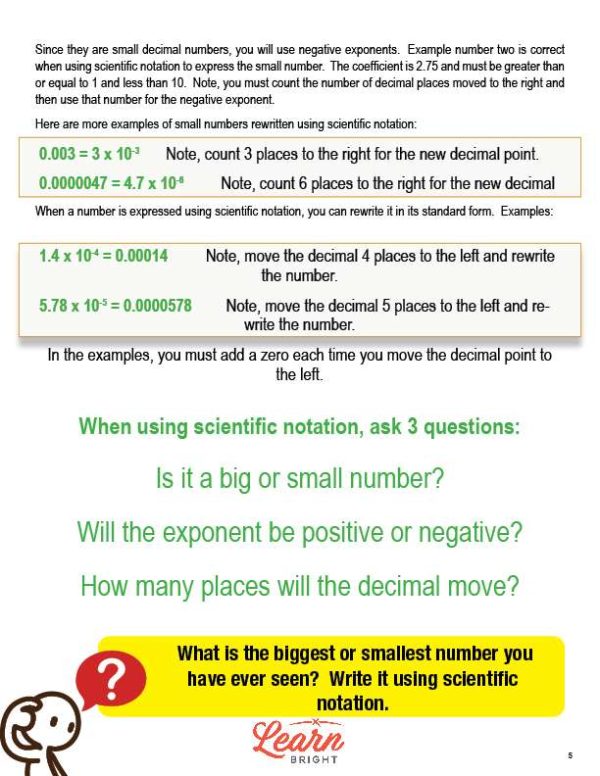
You can also express very small numbers using scientific notation using negative exponents. For example, say a computer chip is 0.000275 mm high. You can write this number in scientific notation as 2.75 x 10⁻⁴. Like with large numbers, scientific notation for small numbers must use a coefficient greater than or equal to 1 and less than 10. In this case, the coefficient is 2.75. Count the number of decimal places moved to the right and use that number for the negative exponent.
Let’s take a look at a few more examples: 0.003 = 3 x 10⁻³ and 0.0000047 = 4.7 x 10⁻⁶. Remember to count to the right the same number of places as the exponent.
Like with positive exponents, you can also rewrite numbers expressed using scientific notation with negative exponents in their standard form. For example, 1.4 x 10⁻⁴ = 0.00014 and 5.78 x 10⁻⁵ = 0.0000578. Simply move the decimal the same number of places left as the exponent and add a zero for each place moved.
When you use scientific notation, ask yourself a few questions: Is it a big or small number? Will the exponent be positive or negative? How many places will the decimal move? You’ll learn how to write numbers in scientific notation in no time!
SCIENTIFIC NOTATION LESSON PLAN WORKSHEETS
The Scientific Notation lesson plan includes three worksheets: an activity worksheet, a practice worksheet, and a homework assignment. You can refer to the guide on the classroom procedure page to determine when to hand out each worksheet.
POSTER ACTIVITY WORKSHEET
For the activity worksheet, students will first create a poster showing the distance of the eight planets from the Sun using scientific notation. Their posters should show the planets in correct order from the Sun. Next, they will write the given number in scientific notation and then label each part (the coefficient, the base, and the exponent).
CONVERSION PRACTICE WORKSHEET
The practice worksheet asks students to convert 20 standard numbers to scientific notation and 20 numbers written in scientific notation to standard numbers.
SCIENTIFIC NOTATION HOMEWORK ASSIGNMENT
For the homework assignment, students will solve seven problems related to scientific notation.
Worksheet Answer Keys
This lesson plan includes answer keys for the activity worksheet, the practice worksheet, and the homework assignment. If you choose to administer the lesson pages to your students via PDF, you will need to save a new file that omits these pages. Otherwise, you can simply print out the applicable pages and keep these as reference for yourself when grading assignments.


