




Description
What our Rounding to Nearest 10 & 100 lesson plan includes
Lesson Objectives and Overview: Rounding to Nearest 10 & 100 teaches students strategies for rounding whole numbers to the nearest 10 or 100. At the end of the lesson, students will be able to use place value understanding to round whole numbers to the nearest 10 or 100. This lesson is for students in 3rd grade and 4th grade.
Classroom Procedure
Every lesson plan provides you with a classroom procedure page that outlines a step-by-step guide to follow. You do not have to follow the guide exactly. The guide helps you organize the lesson and details when to hand out worksheets. It also lists information in the blue box that you might find useful. You will find the lesson objectives, state standards, and number of class sessions the lesson should take to complete in this area. In addition, it describes the supplies you will need as well as what and how you need to prepare beforehand.
Options for Lesson
Included with this lesson is an “Options for Lesson” section that lists a number of suggestions for activities to add to the lesson or substitutions for the ones already in the lesson. One optional addition to the lesson activity is to have your students create additional numbers to round for the activity. For additional practice, you can have your students use numbers they see throughout their day and round them to the nearest 10 and 100. You could also have your students create word problems related to rounding numbers to the nearest 10 and 100, exchanging them with a partner to solve. If you have more advanced students, you can use larger numbers for rounding to 10 or 100.
Teacher Notes
The teacher notes page includes a paragraph with additional guidelines and things to think about as you begin to plan your lesson. This page also includes lines that you can use to add your own notes as you’re preparing for this lesson.
ROUNDING TO NEAREST 10 & 100 LESSON PLAN CONTENT PAGES
Place Value and Rounding
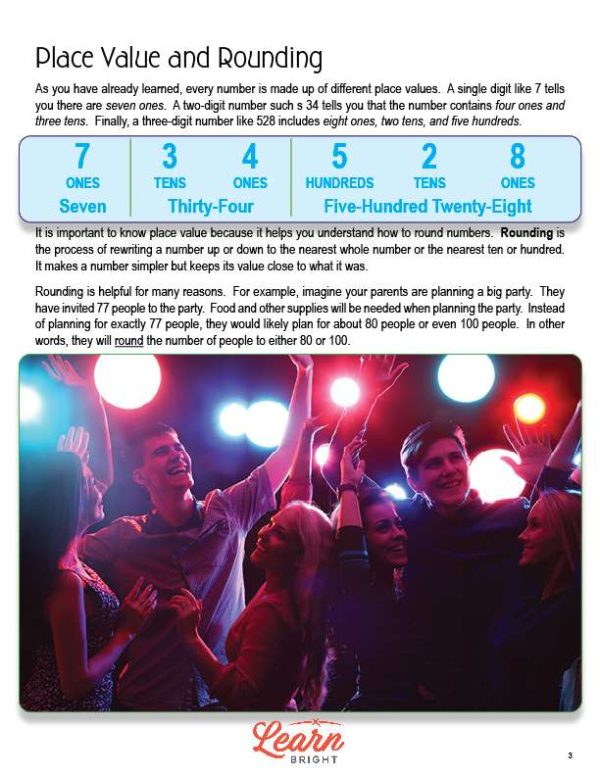
The Rounding to Nearest 10 & 100 lesson plan includes four content pages. All numbers are made up of place values. The number 7, a single digit number, tells you that there are seven ones. The number 34, a two-digit number, tells you that there are four ones and three tens. And the number 528, a three-digit number, tells you that there are five hundreds, two tens, and eight ones.
Understanding place value is important for rounding numbers. When you round, you rewrite a number up or down, to the nearest whole number, ten, hundred, or so on. This makes the number simpler while keeping its value close to what it started as.
Rounding is useful in many different scenarios. For example, your parents might throw a big party and invite 77 people. To plan the party, they need to estimate how many of those 77 people will show up so they can buy the correct amount of food and other supplies. Instead of planning for exactly 77 people to come, they might plan for about 80 instead to make sure they have enough no matter what. They rounded up from 77 to the nearest ten to get 80.
Let’s take a look at another example. If a school event had 326 attendees, the principal might round and say there were about 300 or 330 people at the event when reporting the number of people who attended. The principal rounded the attendance to the nearest hundred or ten. You do not always need to use exact numbers in every situation!
How to Round
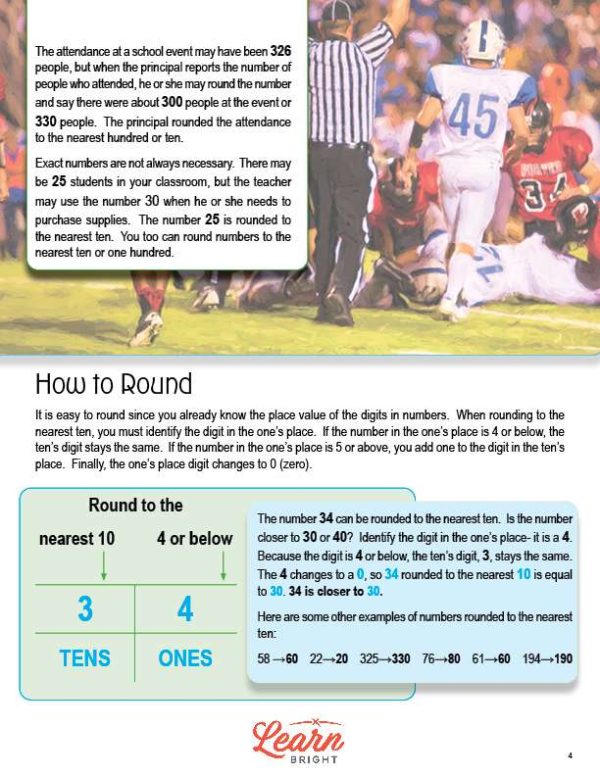
Rounding is easy! To round to the nearest ten, you first need to identify the digit in the ones place. If that number is 4 or below, the digit in the tens place stays the same. If that number is 5 or above, you add one to the digit in the tens place. Either way, you change the digit in the ones place to zero.
Let’s take a look at an example. How do we round the number 34 to the nearest 10? The digit in the ones place is 4. Because it’s 4 or below, the digit in the tens place stays the same and you change the digit in the ones place to zero. Therefore, 34 rounded to the nearest ten is 30.
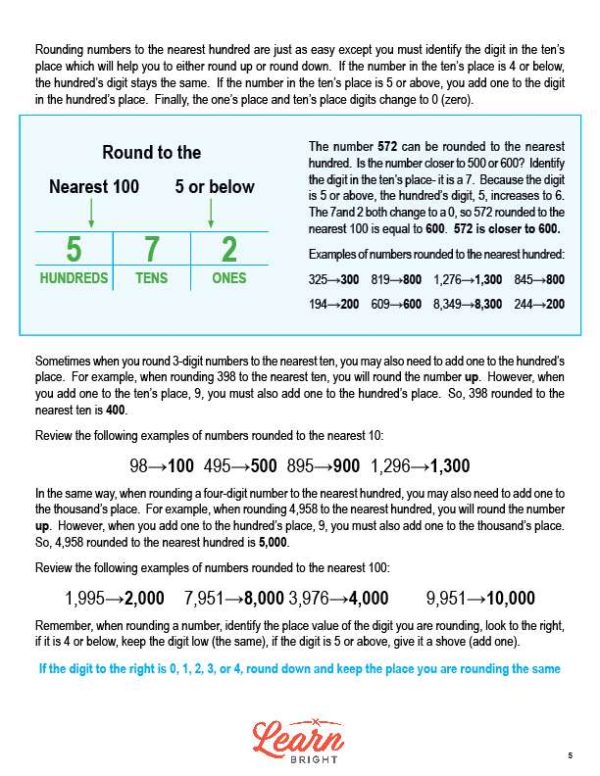
It’s just as easy to round numbers to the nearest hundred, except you need to identify the digit in the tens place instead to determine if you should round up or down. If the number in the tens place is 4 or below, the digit in the hundreds place stays the same. If it’s 5 or above, you add one to the digit in the hundreds place. Either way, you change the digits in the ones and tens places to zeros.
Let’s take a look at an example. How do we round the number 572 to the nearest 100? The digit in the tens place is 7. Because 7 is 5 or above, you increase the digit in the hundreds place by one. You then change the digits in the ones and tens places to zeros. Therefore, 572 rounded to the nearest hundred is 600.
When rounding a 3-digit number to the nearest ten, you might need to add one to the hundreds place. For example, if you wanted to round 398 to the nearest ten, you round the number up. However, when you add one to the tens place, 9, you will also need to add one to the hundreds place. Therefore, 398 rounded to the nearest ten is 400. You can use the same method when rounding four-digit numbers to the nearest hundred or five-digit numbers to the nearest thousand.
When rounding, remember to identify the place value of the digit you’re rounding to and look at the digit on its right. If it’s 4 or below, keep the digit low (the same). If it’s 5 or above, give it a shove (add one)!
Learning how to round numbers to the nearest ten or hundred will help you when you later learn to round larger numbers and decimals. It’s also very helpful for estimating when adding or subtracting.
ROUNDING TO NEAREST 10 & 100 LESSON PLAN WORKSHEETS
The Rounding to Nearest 10 & 100 lesson plan includes three worksheets: an activity worksheet, a practice worksheet, and a homework assignment. You can refer to the guide on the classroom procedure page to determine when to hand out each worksheet.
CREATING NUMBERS ACTIVITY WORKSHEET
Students will work with a partner to complete the activity worksheet. Each pair will first cut apart the digits on the worksheet. They will then randomly select digits to create ten 2-digit numbers, 3-digit numbers, and 4-digit numbers. Finally, they will write out the numbers in the space provided and round them to the nearest ten and hundred.
TENS AND HUNDREDS PRACTICE WORKSHEET
For the practice worksheet, students will round thirty numbers to the nearest 10 and thirty numbers to the nearest 100.
ROUNDING TO NEAREST 10 & 100 HOMEWORK ASSIGNMENT
The homework assignment asks students to first solve five word problems that involve rounding to the nearest 10 or 100. They will also round different numbers to the nearest ten or hundred, such as their age and their street address.
Worksheet Answer Keys
This lesson plan includes answer keys for the practice worksheet and the homework assignment. If you choose to administer the lesson pages to your students via PDF, you will need to save a new file that omits these pages. Otherwise, you can simply print out the applicable pages and keep these as reference for yourself when grading assignments.


