





Description
What our Representing 3D Figures lesson plan includes
Lesson Objectives and Overview: Representing 3D Figures teaches students strategies and formulas to represent 3D figures. Students begin by learning about how 2D “nets” can be turned into 3D figures, such as pizza boxes, which are flat until assembled. At the end of the lesson, students will be able to represent 3D figures using rectangle and triangle nets and solve surface area and real-world problems. This lesson is for students in 6th grade.
Classroom Procedure
Every lesson plan provides you with a classroom procedure page that outlines a step-by-step guide to follow. You do not have to follow the guide exactly. The guide helps you organize the lesson and details when to hand out worksheets. It also lists information in the blue box that you might find useful. You will find the lesson objectives, state standards, and number of class sessions the lesson should take to complete in this area. In addition, it describes the supplies you will need as well as what and how you need to prepare beforehand.
Options for Lesson
Included with this lesson is an “Options for Lesson” section that lists a number of suggestions for activities to add to the lesson or substitutions for the ones already in the lesson. One optional addition to this lesson is to have your students build 3D shapes from nets of various sizes and calculate the surface area for each one. You can also have your students create various side lengths to see how modifying the shape changes the surface area. Another optional activity is to have your students research a product and determine the surface area to see how it would be affected in a store setting.
Teacher Notes
The teacher notes page includes a paragraph with additional guidelines and things to think about as you begin to plan your lesson. This page also includes lines that you can use to add your own notes as you’re preparing for this lesson.
REPRESENTING 3D FIGURES LESSON PLAN CONTENT PAGES
Representing 3D Figures
The Representing 3D Figures lesson plan includes three content pages. In geometry, nets are 2D shapes that you can fold to create a 3D form. When a 3D form is opened up flat to show each face, the pattern that it forms is the next. A 3D form can have many different nets, as there are multiple ways to open up a 3D form.
Nets create solid 3D forms if the net and the form have the same number of faces, the net and the form have the same corresponding shape faces, and all of the sides fit together when folded.
You use nets to find the surface area of a solid object. Many boxes come as nets that people then put together, as they are easier to transport that way. For example, pizza boxes are shipped in their net form and assembled into their 3D forms at the pizza shop right before they put the pizza inside.
Rectangle Net
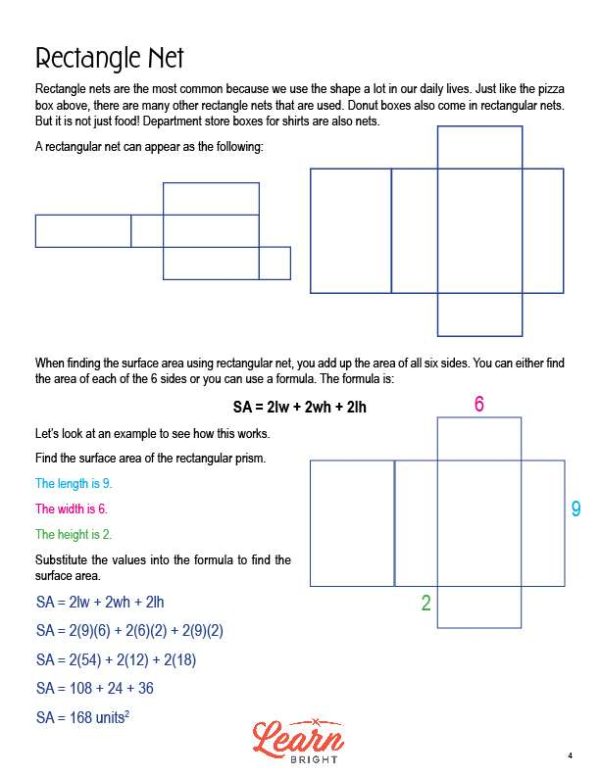
The most common nets are rectangle nets, because this shape is used often in our day-to-day lives. Like pizza boxes, donut boxes come in rectangular nets, as do department store boxes for shirts. Rectangular nets can appear in many different forms, some of which are shown as diagrams in the lesson.
To find the surface area of a 3D figure using a rectangular net, you add the area of all six sides. To do this, you can either find the area of each of the six sides individually and add them together, or you can use a formula. The formula is: SA = 2lw + 2wh + 2lh.
Let’s look at an example. The lesson shows a diagram of a rectangle net and asks you to find the surface area of the rectangular prism. The length (l) is 9, the width (w) is 6, and the height (h) is 2. To solve, substitute the values into the formula: SA = 2lw + 2wh + 2lh becomes SA = 2(9)(6) + 2(6)(2) + 2(9)(2) = 2(54) + 2(12) + 2(18) = 108 + 24 + 36 = 168. The surface area of this rectangular prism is 168 units².
Triangle Net
You can fold a triangle net to create different shapes, depending on its base. You can have a net for a triangular pyramid or a square pyramid. The lesson shows a diagram of a net of a triangular pyramid and shows how to fold it into a 3D shape. The lesson then shows a diagram of a net of a square pyramid and shows how to fold it into a 3D shape. The base of the square pyramid is a square instead of a triangle.
To find the surface area of a triangular net, you need to find the area of each face and add them together. Let’s take a look at an example of how to find the surface area of a square pyramid. To solve, you need to find the area of the triangle and the square.
The area of a triangle is bh. In this example, the base (b) is 3 and the height (h) is 4. To solve, you substitute the values into the formula: area of the triangle = (3)(4) = (12) = 6. The area of a square is s2. In this example, the side (s) is 3. To solve, substitute the values into the formula: area of the square = (3)2 = 9.
Finally, multiply the area of the triangle by 4, since there are four sides, and add it to the area of the square base: 4(6) + 9 = 33. The surface area of this square pyramid is 33 units².
REPRESENTING 3D FIGURES LESSON PLAN WORKSHEETS
The Representing 3D Figures lesson plan includes three worksheets: an activity worksheet, a practice worksheet, and a homework assignment. You can refer to the guide on the classroom procedure page to determine when to hand out each worksheet.
BOXES ACTIVITY WORKSHEET
Students will work in groups to complete the lesson activity. Each group will receive four boxes. They will measure each side and round to the nearest whole number, writing the measurements on the boxes provided. Each group will show their work for each object.
NETS PRACTICE WORKSHEET
For the practice worksheet, students will first look at nets and decide what 3D shape each net makes. Next, they will find the surface area of various nets. Finally, they will draw the net for a given 3D figure and find its surface area.
REPRESENTING 3D FIGURES HOMEWORK ASSIGNMENT
The homework assignment asks students to find the surface area of six different nets.
Worksheet Answer Keys
This lesson plan includes answer keys for the practice worksheet and the homework assignment. If you choose to administer the lesson pages to your students via PDF, you will need to save a new file that omits these pages. Otherwise, you can simply print out the applicable pages and keep these as reference for yourself when grading assignments.


